
Cover Story | By PAMELA DEY VOSSLER | photos by: BAMBI RIEGEL | riegelpictureworks.com
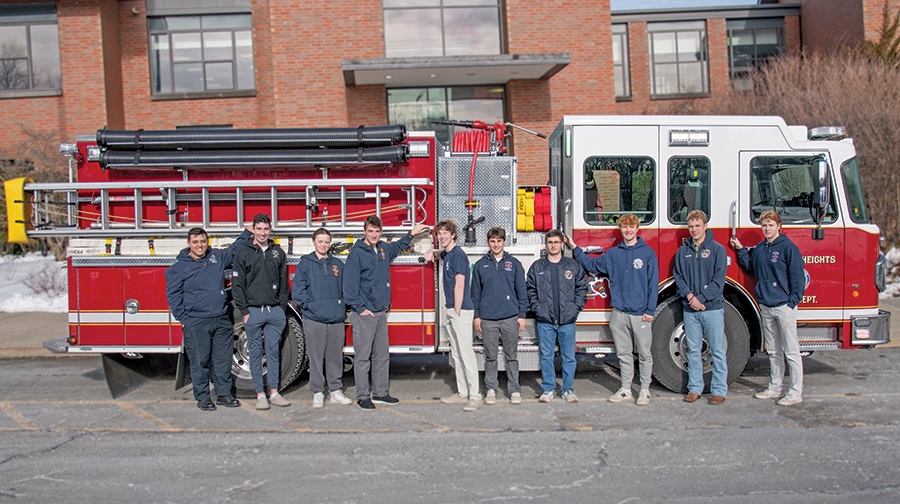
Young firefighters in Darien (from left): Tony Crespo, Gavin Hanig, Cam Seeley, Nate Sweet, Jack Lubeley, Scott Luecke, Nathan Camporeal, Cameron McElrea, Trevor Sheridan and Tate Sedlock
IN THE EIGHT TO 10 HOURS A WEEK (and often more) they give to our town year ‘round—through what they are willing to learn – about themselves, their equipment, and all manner of possible scenarios on the water and on land, and through what they are willing to take on with this knowledge, on top of everything else already packed into their lives—academics, sports, other extracurriculars and more, they are exceptional. Beyond it, really.
They are Darien’s high school firefighters, the 30 students in town who get up in the middle of the night, leave any dinner table, and dedicate a night almost every week and nearly every Sunday morning to training, to make sure that when we call 9-1-1 with a fire, hazmat or rescue emergency, a team of uber qualified first responders will arrive to help.
They are selfless, gutsy, humble and dedicated, willing to help in the most dire situations, to be part of something bigger than themselves …and well aware of just how cool it is to actually ride on a fire truck.
“Not everyone can say that they get to ride on fire trucks every day,” said Darien High School (DHS) Class of ’25 Trevor Sheridan, smiling. He joined the Darien Fire Department (DFD) at 16, the minimum age you must be to apply. Nowa freshman at Auburn University, he still volunteers when he is home.
Fun aside, they make a huge commitment and they’re proud of it. They find the time. It matters to them. It’s all volunteer and they are all in, just like their fellow firefighters, adults of all ages, who are training, mentoring and working alongside them. In fact, 100% of the nearly 200 firefighters protecting Darien across our three fire departments –– Noroton, Noroton Heights and Darien, are volunteers. Collectively, they respond to more than 1,800 calls a year. The high school members are expected to respond to a minimum of 10 percent of them. Depending on where they serve, that’s one to two alarms (or more) per week.
“It’s definitely a lot to balance, but for me, it is worth the time I give up for it,” said Darien’s Tommy Bogdan, a junior at Greens Farms Academy who applied to the Noroton Fire Department (NFD) as soon as he turned 16. “I like helping people and also the camaraderie and knowing that when stuff goes wrong, you can be there to help,” he added.
High school firefighters serve as probationary members (“probies,” they are called), until six months after their 18th birthday. Within 90 days of joining, they must master a Ready-to-Ride training packet of material before they are allowed on a truck.
They are tested in 12 different areas ranging from equipment identification (75 pieces across four different trucks), to how to operate an air pack, put on personal protective equipment in 90 seconds or less, throw a ground ladder to a window and hit a hydrant to get the water flowing.
“It can be up to 30 to 40 hours of training before they can be ready to respond on our rigs,” explained Jack Butcher, who has been the lead for recruiting and interviewing new members at NFD for the past five years. A retired assistant chief, he remains active as a firefighter, as well as in coaching and mentoring the high school kids.
If probies do not pass within three-months, they are released from their volunteer commitment. It is the same standard to which all new members are held, regardless of age. Most pass, needing far less than the allotted time, with help from the officer with which each new member is paired and the many members cheering them on.
“Everyone looks out for each other, from the elected officers to members to probies. Because of the nature of the job, everyone wants everyone to succeed,” said Nate Sweet, a senior at Brunswick School who joined the NFD at 16.
And then there’s regular training— rope rescues, cutting cars to release occupants, confined space drills, cold water rescues, lifting tractor trailers, mock fires staged in the training tower at the Darien dump and more. Offered twice weekly in two-to-three-hour sessions, training is ongoing for every member, even those with decades of experience. Probies must attend at least two sessions a month, but most do more than that.
“We all work off of the same state and federal standards. It’s a very similar level of training the paid departments put their people through,” said Jun Takayasu, DFD captain who works closely with high school firefighters as the training lead and head of the committee that screens all applicants.
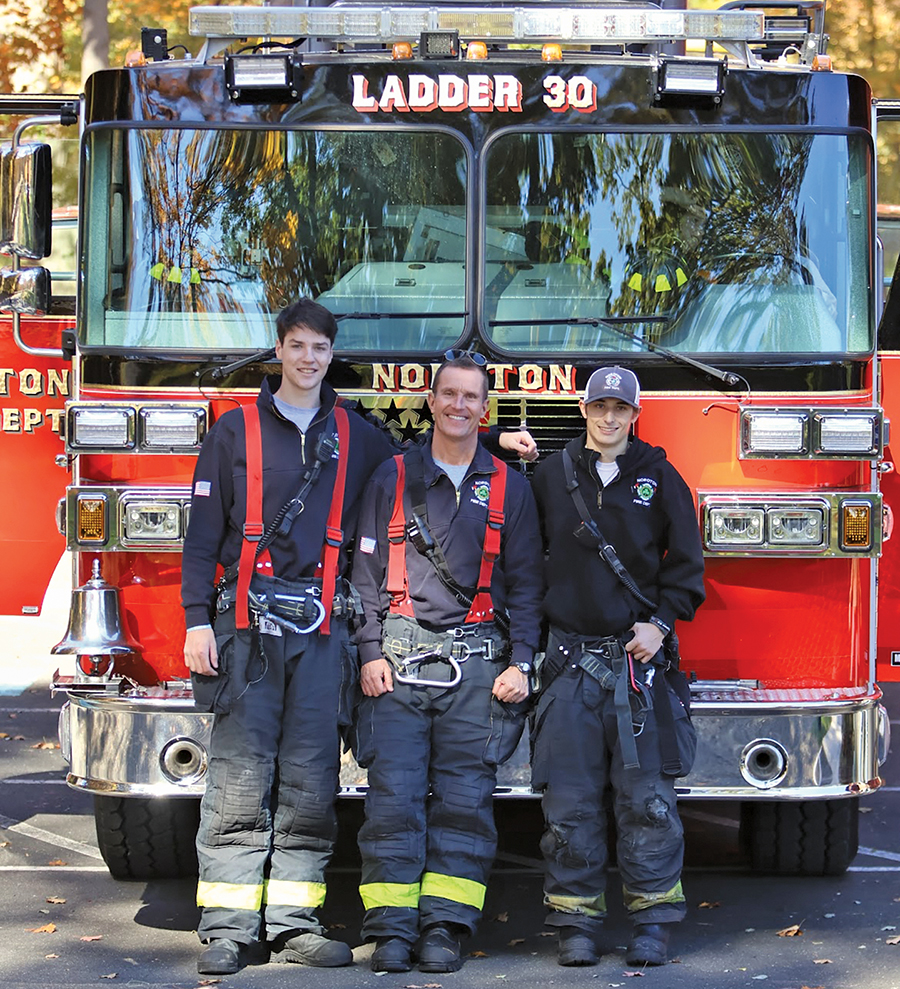
Multi-generational bonding. From left: Finn Hagen, Jack Butcher and Tommy Bogdan | Photo courtesy Tommy Bogdan
However, by state law, even after meeting the Ready-to-Ride criteria and all the additional training, high school members may provide external support only— things such as operating hydraulic tools for vehicle extractions, and ladder, hydrant and hose line work. It is not until they are 18 years old that they may pursue Fire 1 and 2 Certifications to qualify for interior firefighting.
Still, “they are a crucial part of these operations,” said Ryan Plank of the high school probies. Ryan, DHS Class of 2017 and a career firefighter in Stamford, volunteers at the Noroton Heights Fire Department (NHFD) in his spare time. He joined at 16 years old, like his older brother before him, also a career firefighter. He spent the last three years in charge of the probies and was recently promoted to assistant chief. “If everything they do on the outside is right, everything on the inside goes just as well,” he added.
Driven by purpose, a desire to give back and “a culture of high expectations and high performance,” as Jack B. describes it, “These young members train hard to be able to ride on that truck,” he said.
The more they show they can do, the more they get to do, and that’s what they want. “When the officer in charge on the truck turns around and says, ‘Hey, whoever, you’re doing this,’ they want to be that person,” said Ryan.
For everything they give, however, what they get in return is even greater, and these high school firefighters know it.
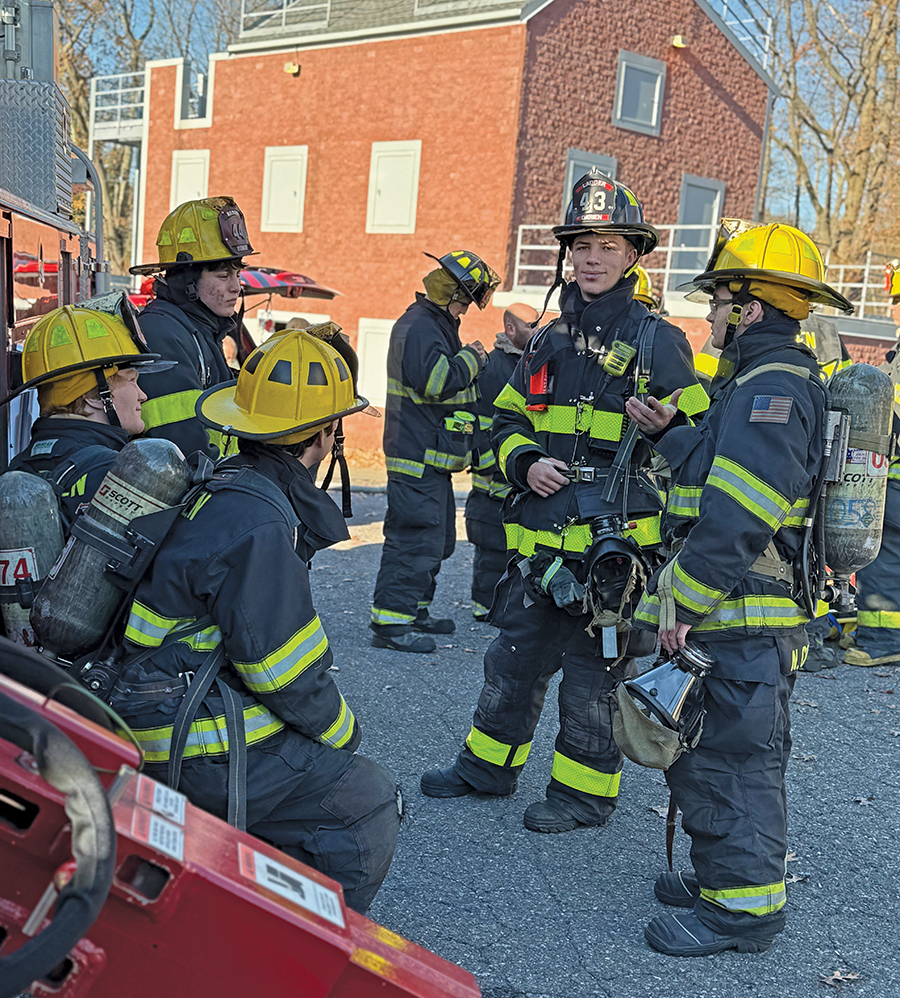
Darien Fire Department firefighters (clockwise from center) Trevor Sheridan – facing forward, Nathan Camporeale, Emre Mesta, Cameron McElrea and Thayer Hewitt. | photos courtesy Jun Takayasu
They find community, connection.
“My favorite part of being a member of the fire department is not only the firefighting aspect, it’s also the people, the traditions and the long line of history and legacy that’s woven into every part of the building and every member,” said Finn Hagen, a senior at DHS who joined NFD a year ago. “The camaraderie is unlike anything I’ve ever seen before.”
“One of my favorite parts is the camaraderie,” agreed Nate. “Everyone is there for the same reason, and there’s a strong sense of mutual respect and teamwork.”
“Being part of the department makes me feel a lot more connected to town,” said Jack Lubeley, a senior at DHS who applied to NHFD on his 16th birthday and joined a month later. “There are always good people there, waiting for you it feels like. It’s a place I like to hang out.”
“It really is a good group of people that you can connect with regardless of your age. If I’m having a rough day, they’re the first people I want to go talk to,” added Tommy.
They learn empathy.
“Nobody who’s calling the fire department is having a good day,” said Jack L.
They discover what exists on the other side of a challenge met.
“It definitely can be hard. Physically, in drills and on calls, at times it pushes me harder than any sport ever did,” said DFD firefighter Thayer Hewitt, a senior at DHS who played on the hockey and soccer teams. “I have learned that challenging myself and stepping up to do something I perhaps have never done before is always rewarding.”
“I wasn’t the most confident person in the world when I first joined the firehouse,” recalled Trevor, “but you get thrown into situations sometimes where you have to figure it out. If you don’t know something, you have to use what you know and learn from it. I’m definitely now a more confident person,” he continued.
“It’s taught me that I can do a lot more than I think I can,” observed Tommy. “I’ve always struggled in school. I have dyslexia, and I didn’t know if these classes I’ve taken and the drills and the skills that we do were going to be something that would work out for me. But it showed me that when
I put my mind to something, I can get really good at it, and enjoy it too,” he said.
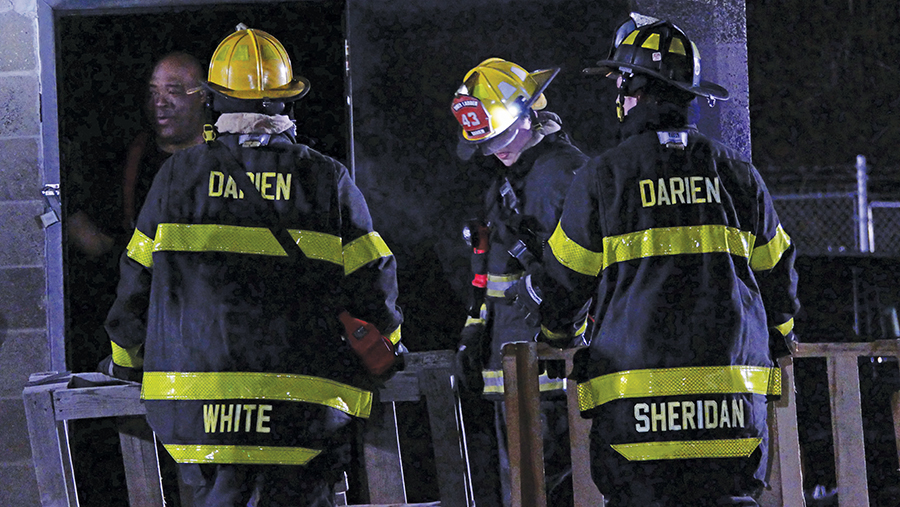
Our all-volunteer firefighters, including the youngest members, respond to calls at all hours. | photo courtesy Jun Takayasu
They learn to think under pressure.
“I’ve never been at a fire or a serious incident where everything goes perfectly. So a lot of it is just taking what you know and being able to come up with a good solution under pressure. For example, if the hose doesn’t have water right when you need it, what do you do? You have to think on your feet, that’s one of my favorite parts—nothing’s ever the same which is always fun,” said Trevor.
“Your ability to learn and grow up is phenomenal in this environment because you’re exposed to all sorts of different experiences and you’re training your mind to think through crises,” added Jun.
They learn the value of mistakes.
“You build strength by gently increasing resistance, psychologically, experientially,” said Jack B. “It’s okay for kids to fail. I want kids to train hard and I want them to make some mistakes. Because I want them to know what it feels like and I want them to know it’s okay to make mistakes in training,” he continued. “Just don’t do it on the fire ground.”
“Mistakes are expected. The mentality is that’s why you practice so much because they want you to mess up, but they want you to mess up when you’re practicing so you can learn,” said Trevor.
They learn it’s OK to say you don’t know.
“I tell these kids, look, sometimes the best thing I can hear is I don’t know, teach me, as opposed to, oh I have all the answers. Nobody has all the answers. I’ve been doing this 45 years and I don’t have all of the answers,” said Jack B.
“The first step on the long road to becoming a dependable firefighter has been accepting that I am young, inexperienced, and must know when to ask for help,” said Thayer. “Training has humbled me countless times, but each time it does, I learn something valuable to apply to real world situations and emergencies.”
“We say the day you stop learning is the day that you should leave,” said Ryan.
They learn responsibility.
“We give them a lot of responsibilities, and they’re expected to meet them. We’re not sitting there babysitting them,” said Pat Conway, captain of the NFD marine division and the officer in charge of new members.
“We’re never going to put them in a position to do something they haven’t been trained to do. But that’s why maturity is so vital to us: If you don’t know, say so,” added Jack B.
“It’s unique in that we trust them and teach them how to do stuff they probably would never get to do unless they were to join the fire department,” Pat continued.
They learn so much.
…like how to change oil, handle a chain saw, fix a flat, open a locked car and the rewards of hard work.
They learn teamwork, balance, time management, commitment. They learn the value of preparation and the importance of advocating for themselves. (“It’s one of the biggest things I stress with the high school kids. It’s not just going to happen for you,” said Jun.)
“I’ve learned that I really enjoy working in high-responsibility, hands-on environments where what you do genuinely matters,” said Nate. “Being involved has given me a sense of purpose and connection to my town that I wouldn’t get anywhere else,” he continued. “It’s not something that I have done casually, and that has been amazing. I get to feel good about what I do,” he continued.
“I love doing it. It’s really changed my life for the better,” said Tommy.
Ours too Tommy. Ours too.