Our Summer this Holiday Season
The Good Table | written by: SEÁN LEARY, Leary’s Liquor Cabinet
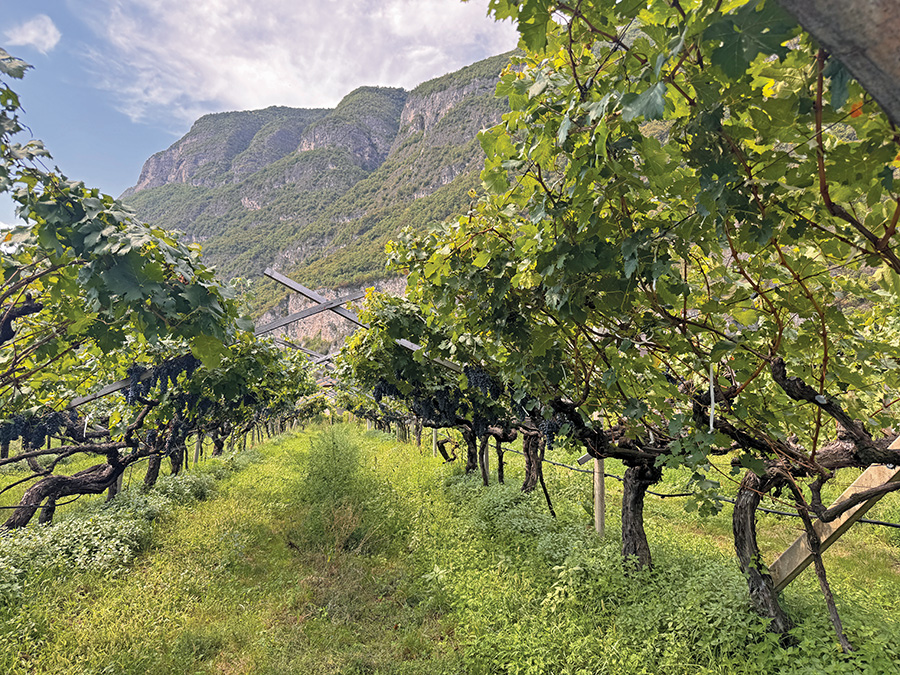
148-year-old ungrafted vines of Bordeau varietals at the Löwengang Vineyard in Margreid / photo courtesy Seán and Alex Leary
The year is 1918. You live in an Alpine city on the Etsch river, a subject of the Habsburgs. A few weeks later, you’re a subject of the King of Italy, living in the same city, now on the Adige. You haven’t moved an inch.
Fast forward 108 years. Welcome to Südtirol-Alto Adige! You’re a wine lover from Darien in the middle of an Alpine city with two names, Bozen or Bolzano, depending on who you ask. Every sign says everything twice, once in Italian and once in German, and by the end of the first afternoon your head is spinning. Understandably, when my better half, Alex, and I were there last summer, I did the sensible thing and asked for a glass of Pinot Grigio. The waiter brought me a Grauburgunder. Same grape, different language, and somehow, it all made sense.
Alex is of Tyrolean descent, and her cousins in Innsbruck had warned us that the South Tyroleans are a different people entirely. A few glasses in, I could see they were half right. Different, yes, but the kind of different that comes from keeping the best of two cultures instead of choosing one.
Some might say what makes the wines here so distinctive is the steep valley walls that make for dramatically sloped vineyards, a climate warm enough to ripen grapes fully despite the altitude, or a patchwork of soils that lets almost any grape variety thrive. I personally think it’s the people.
At the Weingut Tiefenbrunner, we met Johannes, the seventh generation of his family to make wine there. You couldn’t find a more Tyrolean family line, yet every other sentence began with a thoughtful “allora.” Unmistakably Italian, too.
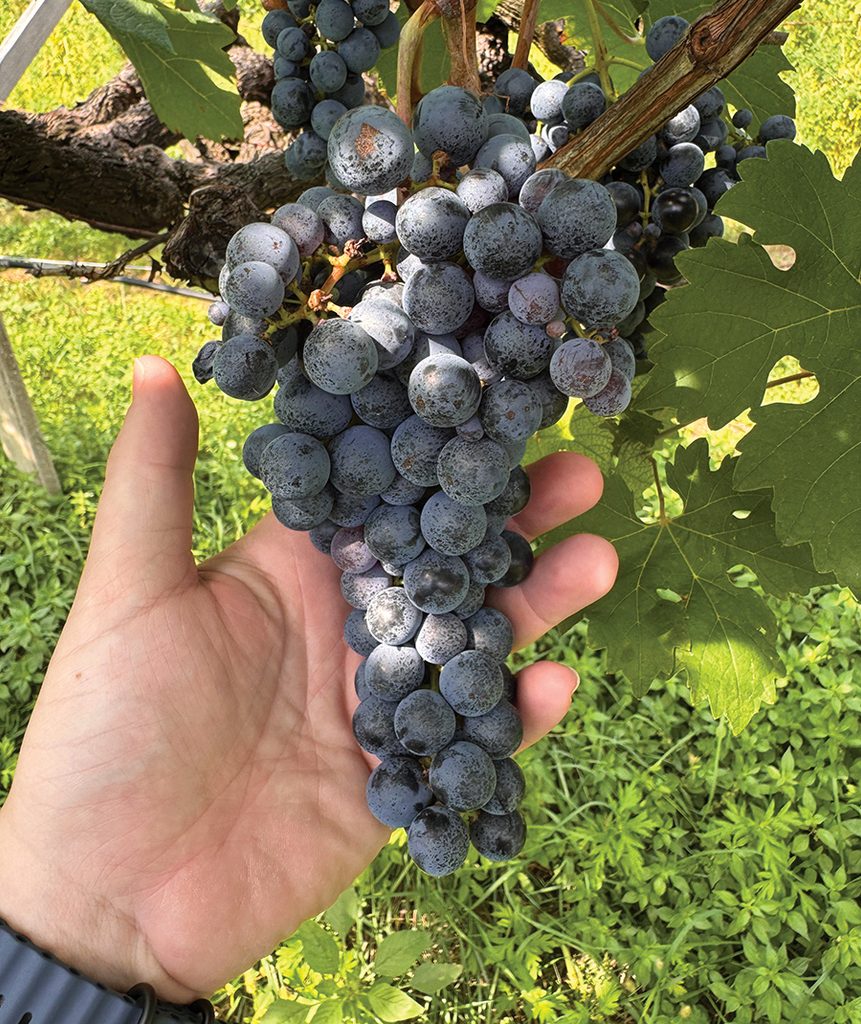
Cabernet Sauvignon grapes from the Löwengang Vineyard / photo courtesy Seán and Alex Leary
I’m a firm believer that the best part of working in wine and spirits is the people we get to work with. I also love family-owned businesses. That might sound like low-hanging fruit, since Leary’s is one too, but I truly do. One of those families is the Lageder clan, originally of Bozen and now based in Margreid an der Weinstraße, or “Margreid on the Wine Road.” The Lageder family farms biodynamically, which means treating the vineyard as a single living farm: no synthetic fertilizers, herbicides or insecticides. Instead, they rely on cover crops between the rows, herbal preparations to keep the vines healthy and the phases of the moon to time planting and harvest.
In the best way possible, I have never been to a noisier or livelier vineyard. The bugs in the grass between the rows chirped so loudly we had to raise our voices to talk over them. Even the songbirds overhead played their part, eating the insects that would otherwise harm the vines.
The moment it clicked for me was when we sat down with the Lageder team to taste through their entire lineup. It was deep, with a little something for everyone: French varieties like Chardonnay, Cabernet Sauvignon and Pinot Noir alongside traditional Tyrolean grapes like Lagrein and Schiava. We tasted alongside cheese and cured meats from the estate’s own cattle, the same herd that works the vineyard. Nothing at Lageder is wasted.
Moments before, we’d been standing in a Chardonnay vineyard at the foot of a 500-foot sheer cliff, inside the village limits of Margreid. The rows seemed counterintuitive. The valley wind runs south to north, but these vines were planted east to west. It turns out the cliff face creates a breeze perpendicular to the main valley wind, and it runs right down those rows. Then we tasted the wine from it, and I may have said something unprintable.
It was that good.
We also walked through a 148-year-old vineyard of ungrafted Bordeaux varieties, planted before phylloxera reached the region. Standing there, I was amazed that one small corner of Italy could bring together the best of so many other wine regions.
Most wine in Südtirol actually comes from cooperatives, and that’s family business too, just on a bigger scale. Kellerei Bozen is made up of about 300 grower families, all pulling in the same direction. Each one has a stake in the winery, farms its own small plots and brings something different to the table. Their winery is also carbon negative, and they even sell their excess carbon dioxide to Forst, a local brewery behind an amazing pilsner. Where Lageder showed us the rustic side of clean, low-impact winemaking, Kellerei Bozen showed us it can be high-tech, too.
What stayed with me most was the noise and life of those vineyards and cellars, full of people so passionate about their work that they felt like family. That’s exactly what a good holiday table should feel like: lively, noisy, everyone happy to be there together and everyone with something they love in their glass.
So this holiday season, drink what you like, with the people you love. If your table needs a little something for everyone, look to Südtirol, or Alto Adige, depending on who you ask. Either way, it’s a toast worth making in two languages: prost and salute!
For more information and wines from this region, visit Leary’s Liquor Cabinet at 186 Heights Road in Noroton Heights, or call them at 203-655-0508.