
Our Town | written by: TERRIE WOOD, State Representative, 2009 to 2023 , and JAYME STEVENSON, First Selectman, 2011 to 2021
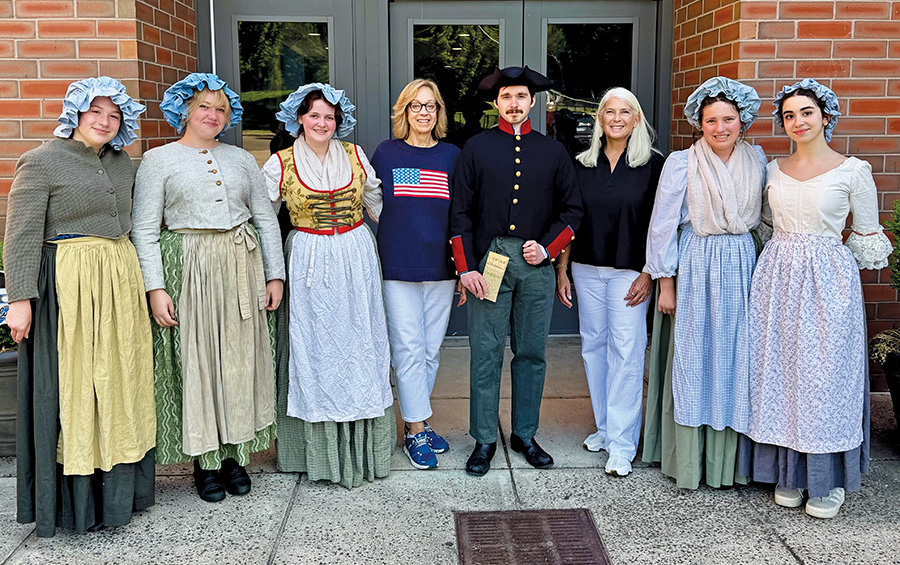
Terrie Wood (4thfrom left) and Jayme Stevenson (3rd from right) with members of Theatre 308 at the 2025 Declaration Day Ceremony
Authors’ note: We were inspired to start a July 4th Declaration Day Ceremony in Darien four years ago after attending a similar ceremony in Greenwich. We felt that our town too should take time, as Greenwich and towns across the country do, to celebrate the inherent freedoms we have today (yet often take for granted), to remember the passion and clearheaded vision of our Founding Fathers that gave us those freedoms, and honor our residents who are currently serving in the military to defend them.
As we look to the 2026 Declaration Day Ceremony and its extra import this year at the anniversary of the 250th signing of the Declaration of Independence, we present this view of the enlightened courage of our Founding Fathers, whose hope for our country endures today.
AT A RECENT BOOK GROUP DISCUSSION of Thomas Paine’s Common Sense led by the ah-mazing new Mather Homestead Executive Director Samantha Gault, we were struck anew by its central role in the founding of our country, and the courage of our founding fellow Americans to heed its call. It framed the reasons for the push by colonists for independence from Britain and for what became the Declaration of Independence.
COMMON SENSE CREATED
Benjamin Franklin met Paine on one of his trips to London. Impressed by his intellect, his forward-thinking political philosophy and passion for a representative government, Franklin encouraged Paine’s journey to the colonies.
Paine published Common Sense in January 1776. Though just a 47-page pamphlet, it captured the hearts and minds of the colonists who were becoming increasingly angry over the authoritarian rule of King George III, especially his taxation without representation. Common Sense told of a new way of thinking about governance and framed the argument for independence.
With stories both moral and political, Paine gave voice to the pursuit of liberty and self-governance. It inspired readers to weigh the merits of a government based on egalitarian values (equal rights). Educating the colonists on the key ideas of self-governance was revolutionary thinking at the time.
By the spring of 1776, as word spread about the British King’s failure to address colonists’ complaints against Parliament, more and more colonists began to consider the gutsy move toward independence. With Common Sense, they had a framework for their rebellion.
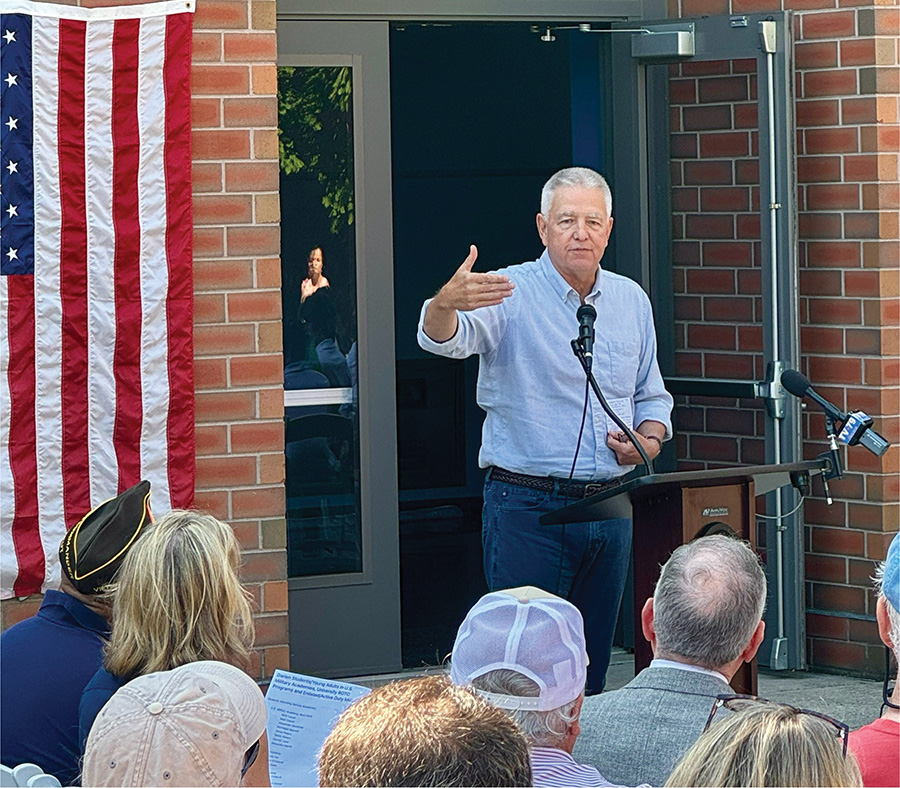
Darien resident Bob Patton, grandson of General George S. Patton
COMMON SENSE IN ACTION
In June 1776, Thomas Jefferson authored the first draft of the Declaration of Independence. Benjamin Franklin, John Adams, Roger Sherman and Robert Livingston assisted with subsequent drafts. After multiple revisions, 56 men from the 13 colonies voted to accept the Declaration in the second meeting of the Continental Congress in Philadelphia on July 2, 1776. It was printed and signed on July 4, 1776.
The Declaration set the foundation for the beginning and evolution of self-governance “by the people and for the people” and has provided for the longest running constitutional republic in the history of mankind—a system of government where the people elect representatives, strictly bound by the rules set in the U.S. Constitution, to make laws for them. As familiar as this now is to us, at the time, it was a totally new idea and broadly debated. No country on earth had ever lived with a bottom-up government—giving voice and power to the people rather than a king or dictator. In astounding tribute to Common Sense, and the people who adapted it to our country’s founding document, the values set forth in the Declaration of Independence have proven resilient—even in times of great tempest.
This is what we celebrate on Declaration Day.
COMMON SENSE CELEBRATED
Some Fun Facts
The first public celebration of the Declaration of Independence took place on July 8, 1776 at State House Yard in Philadelphia, with a reading by Colonel John Nixon accompanied by ringing bells throughout the day. The first anniversary celebration occurred on July 4, 1777 also in Philadelphia.
• John Adams famously believed July 2nd (the date of the vote) should be the day of celebration though the public quickly adopted July 4th—the date on the printed, approved document.
• After the Declaration was passed, the Continental Congress ordered 200 copies to be printed and distributed throughout the colonies. Today, 26 original copies remain.
• The signers sent a copy of the Declaration to King George III with only two names on it: John Hancock and Charles Thomson, the President and the Secretary of the Continental Congress respectively. Why? They didn’t want the British to have the names of all those committing treason.
• To avoid damage, the Liberty Bell has not been rung since 1846. Instead, every July 4th, it is symbolically tapped 13 times in celebration.
DECLARATION DAY IN DARIEN
when: Saturday July 4th at 9:30am
where: Darien High School Courtyard
what:
• A reading of Darien residents currently serving in the military
• Patriotic music by the Darien Community Band
• The Declaration of Independence, brought to life by DHS Theater 308 students
• A keynote address from author and Darien resident Bob Patton, grandson of General George S. Patton,
The annual Push Pull Parade hosted by Darien VFW Post 6933 will step off at 10:30am from Darien High School immediately following the ceremony.