
The Good Table | written by: SEÁN LEARY, Leary’s Liquor Cabinet
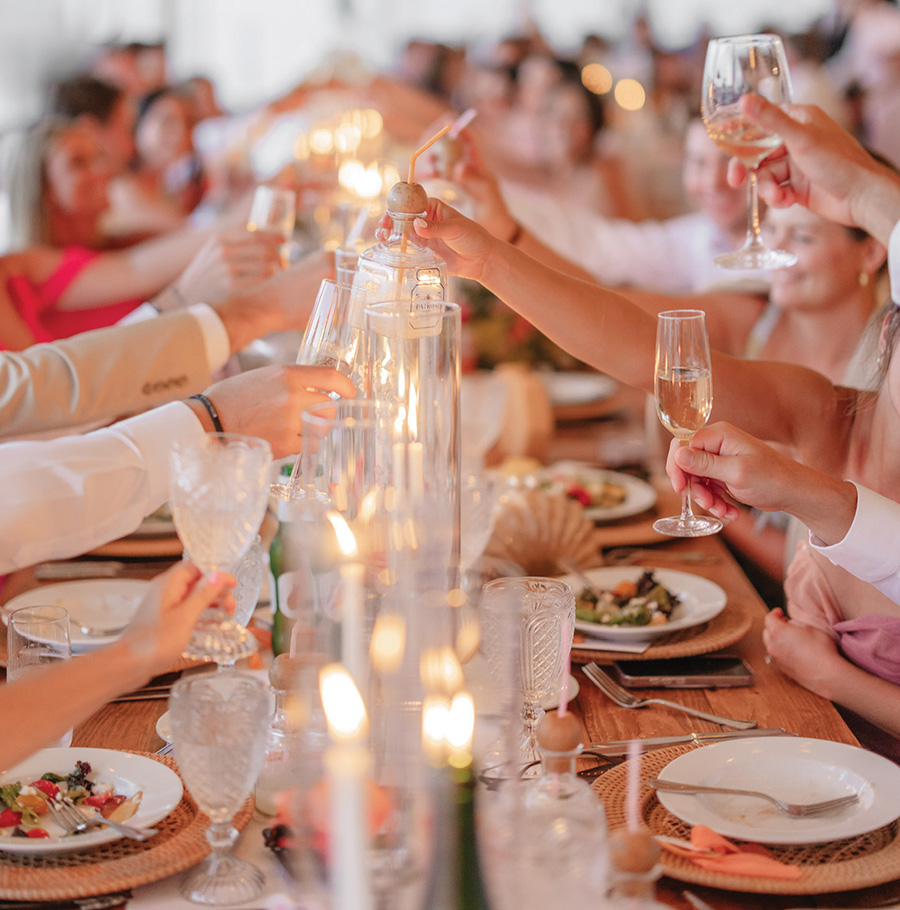
Photo by AlyVPhotography, courtesy Haley Reddish and Kyle Cornell
VEUVE CLICQUOT, MOËT & CHANDON, DOM PÉRIGNON: Everybody knows the most famous “brands” of Champagne, but what exactly makes that bright orange label from Veuve materialize in your imagination when you think about bubbles? To be called Champagne, it must come from Champagne, France. So what else? To be frank, the most readily perceptible differences between bottles of champagne are the branding and pricing structures.
To get knee deep into the nitty gritty of what really makes each of these bottlings unique, you have to first dive into what makes the region of Champagne unique: the dirt!
CHALK TALK
Picture yourself in the rolling hills of Champagne. Now picture that same setting 90,000,000 years ago. If you see the same rolling hills, just populated with a thriving population of dinosaurs, I hate to disappoint: you’re a little off the mark. Champagne 90MYA was under 10,000 feet of water, and had been for quite some time. Over tens of millions of years, the layers upon layers of discarded shells from long forgotten prehistoric sea creatures accumulated until there was a layer of roughly 200m sitting on the prehistoric seabed! As the oceans retreated and this seabed was exposed once more, these layered sediments condensed into a tremendously dense, yet porous chalky rock. This Craie Champenoise (for all the armchair prehistoric geologists out there), is great for drainage, supporting intense minerality and high acidity (both key to making great sparkling wine).
CÉPAGE CHAMPENOISE
The traditional grape varietals of Champagne all shine on this calciferous soil unique to the region. Pinot Noir, Pinot Meunier, and Chardonnay have been grown in Champagne since at least the 13th Century. All three varietals can be blended together in any proportions to create wine in Champagne, although the most common blends are primarily Chardonnay dominant.
CAVES & CUVEÉS
Now that we’ve got the soil and primary grape varietals under our belt, we can dive deep into the vinification process that makes Champagne so unique. To start, all wines are fermented once to turn the residual sugar in the grape must into alcohol. However, in Champagne the wines undergo a second fermentation once bottled to produce and diffuse carbon dioxide into the wine to make it bubbly. Compared to other sparkling wine production methods, this is tremendously more labor intensive, cost intensive and far riskier. Until the early 1800s, bottles regularly exploded during their second fermentation, costing some producers an entire vintage’s worth of stock! (There’s an intense scene featuring this in the 2023 film, Widow Clicquot.)
These now-bubbly wines are aged in the traditional caves beneath Champagne (a mixture of Roman-era limestone chalk mines, storage tunnels used by Benedictine monks and makeshift bunkers used by the civilians of Reims during WWI – making Champagne a wine for history buffs as well). The length of aging depends on the winemaker’s preference, or even cuveé by cuveé (batch by batch). Some winemakers will either blend multiple vintages together to create a non-vintage Champagne, whereas others will only use wine from grapes picked in a singularly amazing vintage and produce a vintage Champagne. The majority of bottlings we are familiar with in the States are non-vintage, yet we all know at least a few vintage Champagnes, such as Dom Perignon. This entire process is mandated by law by the Champagne AOC (Appellation d’Origine Contrôlée, basically the local growing association that sets these rules).
How does this compare to other sparkling wines of the world? Some wines (especially the more price competitive bottlings) use a forced carbonation method rather than a secondary fermentation, and other winemaking regions will allow the second fermentation to occur in a giant stainless-steel tank, resulting in wider availability and larger production quantities. (Looking at you, Prosecco).
FROM VINE TO WINE
So here’s a dilemma: Champagne’s vineyards are finite, and there are only so many grapes to go around. Conversely, there are more champagne producers than you can count! How do they manage to share the spoils? By buying each other’s grapes! The majority of the large champagne houses (think Veuve Clicquot, Moët & Chandon and Billecart) make wine with grapes they’ve purchased from independent growers. These wineries are referred as Négociant-Manipulant (NM) producers (Merchant-Makers). However, we can also find bottlings from producers who control the entire process from vine-to-wine, legally defined as Récoltant-Manipulant (RM) producers (Grower-Makers). Thankfully, the Champagne AOC has made it incredibly simple to tell the difference through an NM or RM placed somewhere on the label, with a series of numbers identifying the exact producer.
BEYOND THE LABEL
Champagne is a subject with surprising depth. How it’s made, the traditions of the people who make it and the unique pre-historical coincidences that allow for its production are the elements that mark one type of champagne from another, not the label.
As with all wines, the winemaker’s choice of grape varietals (cepagé) determine the taste of the champagne, as do the materials it is aged in and how long it is aged (élevage). Finding the perfect bottle to bring home is entirely up to you, and we all have our favorite producers and styles, whether the wine is from a large Champagne house, or a smaller independent grower.
Editor’s note: Whether you’re giving a gift, toasting a special occasion or looking to raise ordinary to the extraordinary, the knowledgeable staff at Leary’s is standing by to help you choose the champagne that’s right for you.