
Our Town | By PAMELA DEY VOSSLER with special thanks to ASMT/Darien Scouting leaders JOELLYN GRAY, TODD MORGAN, ROB FARLEY, LIS STEINBERG, SUSIE FLAHERTY, PAM GARRITY, and ROB GURLIACCI
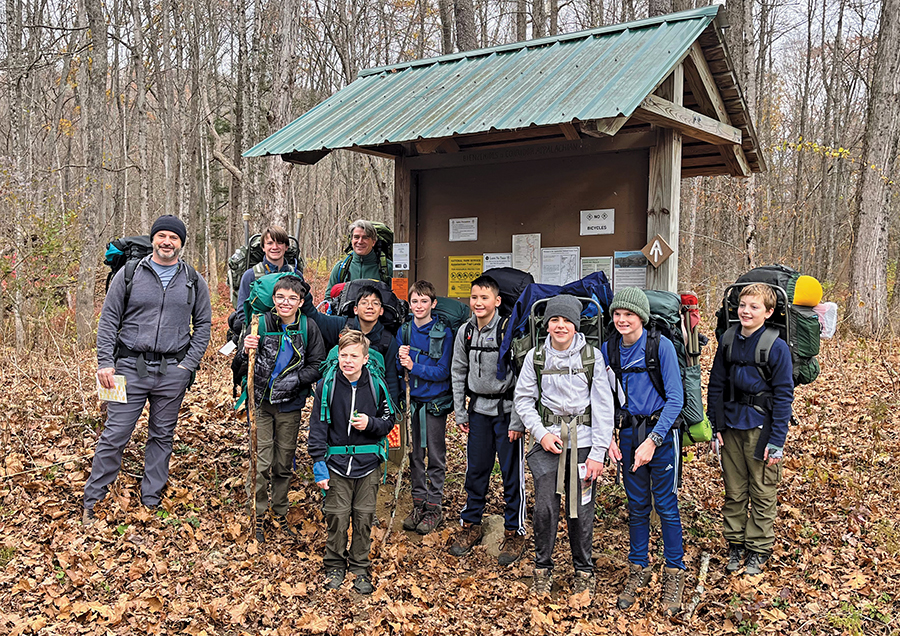
Troop 53 members (in back, from left): Connor Dey, parent volunteer Matt Dey; (middle, from left): Assistant Scoutmaster Rob Farley, Christian Lewis, Noah Livingston, John Hall, Will Takayasu, Willie Eldridge, Kevin Garrity and Tyler Harris. (in front): Hudson Farley / photo courtesy Darien Scouts
Imagine: You’re 11 years old. Maybe 12 or 13. You’ve got a pack on your back that feels like a fridge. You’re hiking up, relentlessly. The pull to quit is strong. But that is not an option: You’re on a trail, deep in the woods. There are kids in front of you, kids behind you, all counting on you to continue …to do your part to make camp, set up a tent, collect wood and light the fire you’ll need to cook a meal. Maybe it’s even your job to cook—over coals. Perhaps it’s raining, or cold. If you’re older, chances are you are leading all this.
Welcome to Scouting America and the 330 boys and girls in Darien who participate in the program through the Andrew Shaw Memorial Trust (ASMT) each year wouldn’t have it any other way. They know the fun of it. They know the rewards.
“Despite the hardships you may encounter you will make incredible friends and become infinitely more confident,” said Darien High School (DHS) senior Natalie Smith of Scout Troop 219. She has been in the program since it began admitting girls in 2019. “How many people can prepare and cook chicken kebabs over charcoal in the woods when it’s storming out with their friends? Unique experiences like that, and the knowledge you get, are what make Scouting worth it,” she continued.
Scouts is a path to leadership, resilience, self-certainty and independence for any young person who wants it—a peer-led, clique-free zone for a wide range of kids ages 11 to 18. It uses outdoor adventure, skills development and community service underpinned by The Patrol Method (“Train ‘em, trust ‘em and let ‘em lead!”) along with a system of values that can’t help but advance belief in self and others, cultivate character, promote self-sufficiency and instill knowledge, all while fostering a sense of belonging and an appreciation for the connection to be found with people outside your regular friend group.

Rank advancement (and the culture of Scouts) is dependent on older scouts teaching and leading younger scouts; Shown here: Nick Lucas with two young Scouts in Darien
“Scouting pushes boundaries and enables you to grow. You meet people you otherwise wouldn’t and are given dozens of other perspectives,” added Natalie. “The independence you gain is freeing,” she said.
No wonder the young people who commit to Scouts develop a comfort in their own skin and an outsized ability to achieve, to handle whatever life throws at them, with discipline and respect.
“It’s important stuff that you’re learning,” said Tate Hanson, DHS Class of ’21 and an Eagle Scout – the highest of the seven ranks a Scout can achieve. “It’s not like you’re just tying a whole bunch of knots. You’re learning how to engage with people, engage with the community, and everybody gets a chance to lead,” he continued. Also a Post 53 alum, Tate graduated from Virginia Tech last December. He’s currently back at Post 53 serving as a supervisor while he applies to medical school. “(The things you learn in Scouts) help you excel in a whole bunch of ways,” he added.
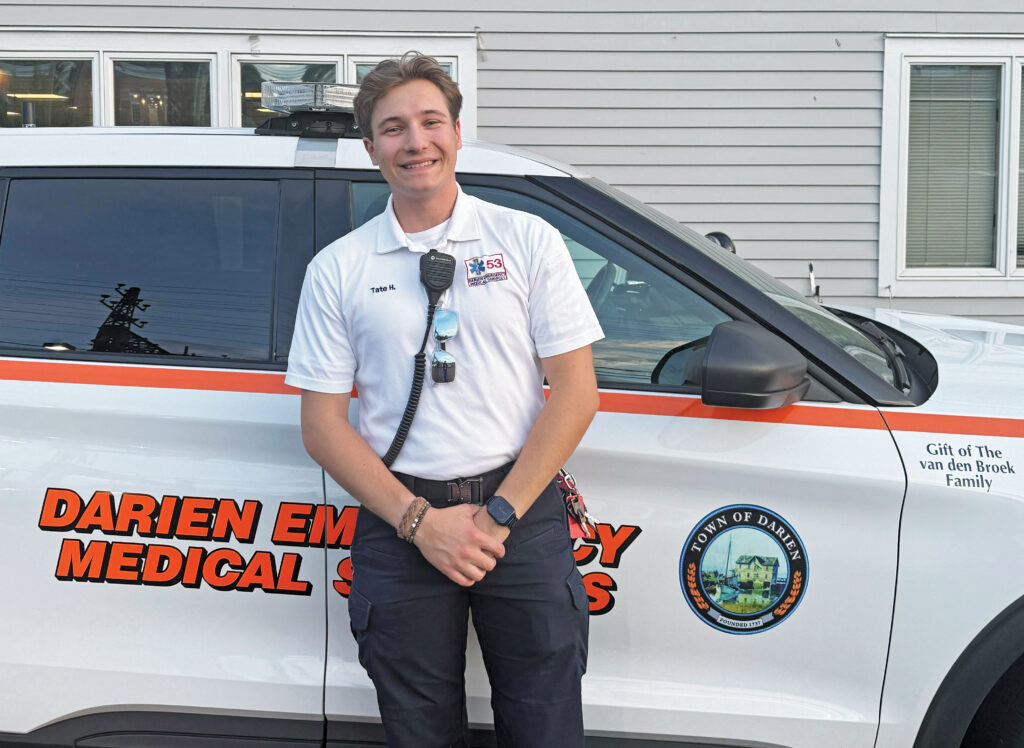
Tate Hanson at Post 53 / photo courtesy of family
“Scouting gave me lifelong friends, incredible experiences, and valuable mentors. (It) provided a strong support system that made it possible for me to do some amazing things,” said Ian Holly, an Eagle Scout and senior at the University of Pennsylvania where he is studying mechanical engineering. He also rowed throughout high school and all four years at Penn as part of the varsity crew. Last summer, he competed in the U-23 World Rowing Championships in Poland.
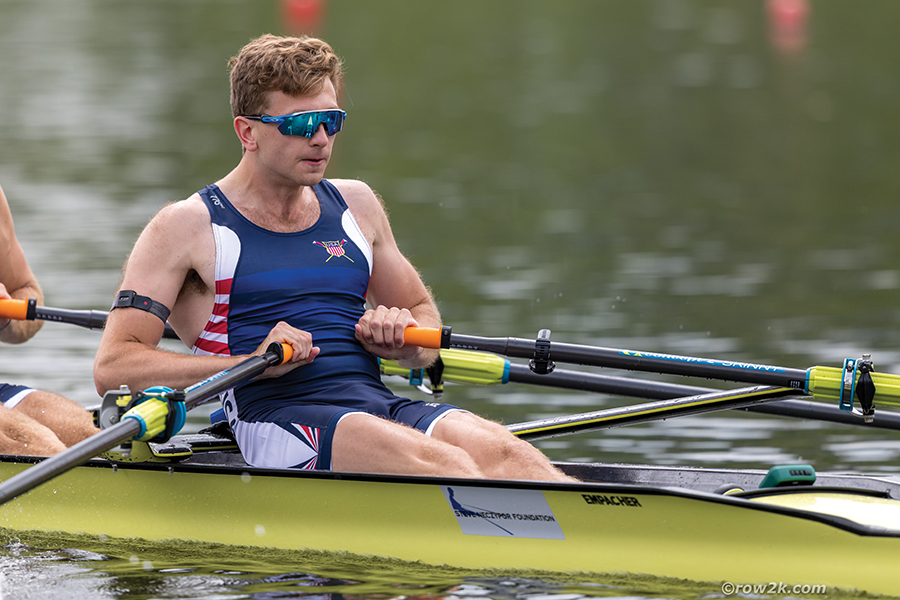
Ian Holly at the U-23 World Rowing Championships last summer / Photo courtesy Row2K
“Scouting has been a major part of my life,” said Nick Lucas, DHS Class of ’25, also an Eagle Scout. He is currently a freshman at West Point. “It taught me leadership, character, selfless service, and has given me a community of people that I can rely on and trust,” he added.
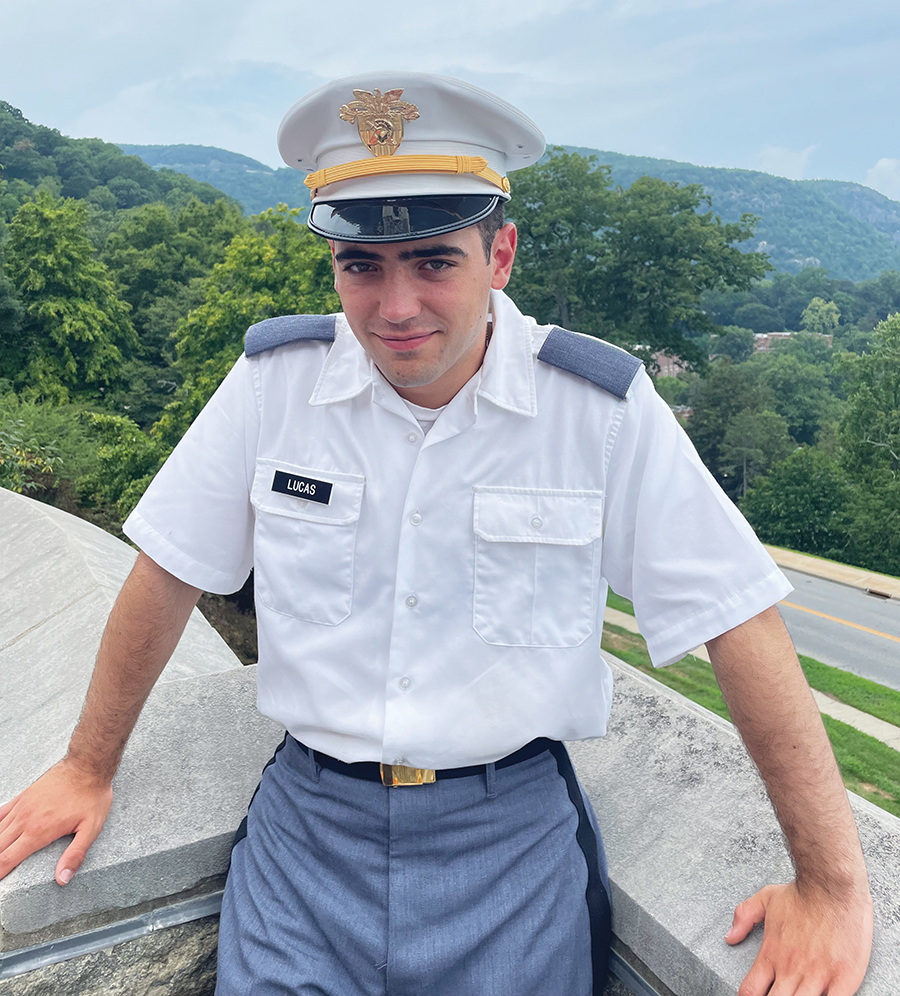
Nick Lucas at West Point / photo courtesy of family
In Scouts, the older kids teach the younger kids, at every stage. It is a place to succeed because it is a safe place to fail. Everybody does. They let you, surrounding you with a supportive circle of peers to pick you up, dust you off and help you correct your mistakes so that you learn from them and understand there is always a way forward, the same way they did. (You get no credit for skills in Scouts until you teach them to another.)
Parents and adults run Cub Scouts for the children who participate in this precursor to Scouts. In Scouts, they serve behind the scenes as ASMT trustees, board members, Scoutmasters, Assistant Scoutmasters—accompanying scouts on camping trips, attending meetings and leading rank advancement interviews, and in a range of other supporting roles for each troop. However, they weigh in directly with the Scouts only when asked or when safety is a concern. It is an all-volunteer group of more than 50 adults, many of them former Scouts themselves, heavily invested in giving young people a powerful leg up to life.
While the Scouts program begins with Cub Scouts, which kids can join any year of elementary school, it is not a prerequisite for Scouts. Many kids join at 11 years old, when they are old enough to go straight into Scouts, and even after that.
“We’ll meet kids where they are,” said ASMT Board Member and Troop Leader Lis Steinberg of the two troops for boys (#53 and #35), the troop for girls (#219) and the four Cub Scout packs at Darien’s elementary schools. “There is a place for everyone.”
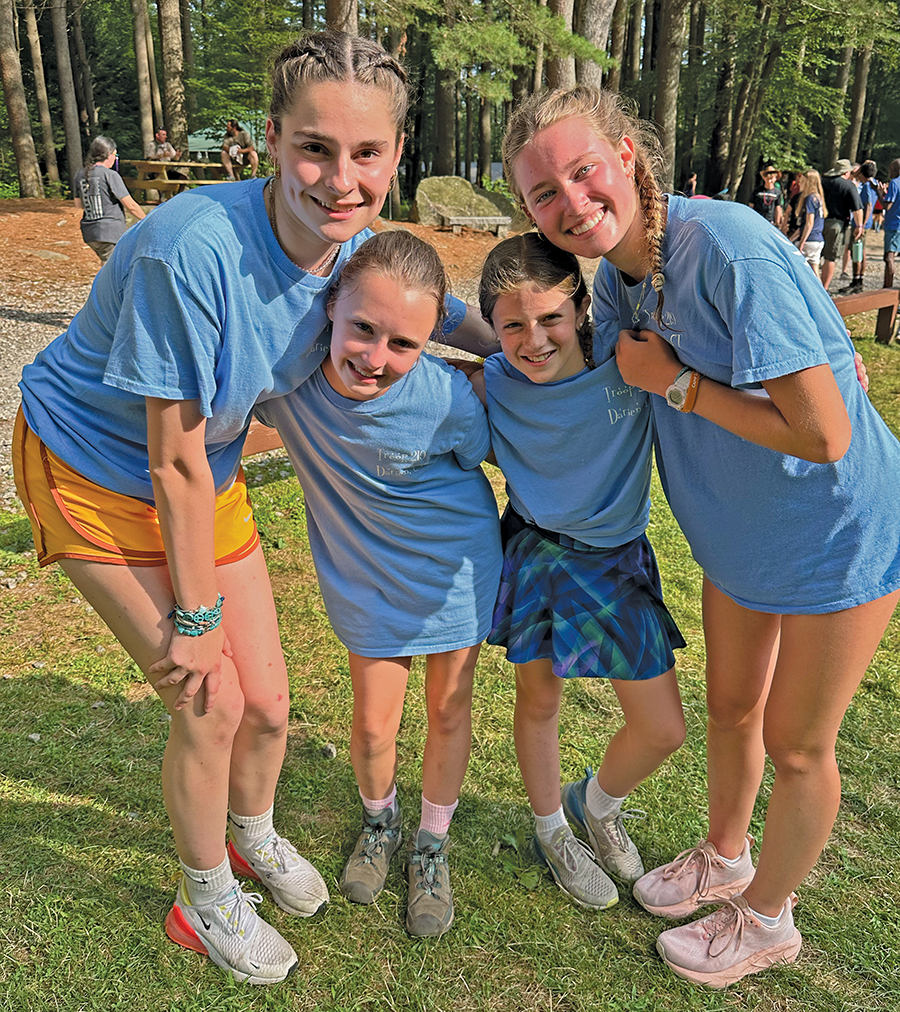
Troop 219 members (from left): Paige Garrity, Ashlinn Cunningham, Teagan Farley and Eliza Hall /
photo courtesy Darien Scouts
Each rank in Scouting has its own set of requirements including merit badges that Scouts must earn to advance toward Eagle. To achieve Eagle, Scouts must earn at least 21 of the 137 available merit badges. Each is tied to a different subject. None are easy. All are interesting (law, electricity, sustainability, first aid, plumbing, citizenship, emergency preparedness and more), and fun (swimming, snow sports, fishing, motor boating and more).
Scouts camp monthly in places along the Appalachian Trail including Bear Mountain and the Delaware Water Gap. They meet weekly to build the skills required for those trips and work toward rank advancement. They take on three major community service projects each year. (Aspiring
Eagle Scouts create community service projects of their own.) There is a summer camp in northwestern Connecticut and more challenging trips to places such as the wilderness of New Mexico.
Though rank advancement is engrained in Scouts, it is not mandatory. But all Scouts grow from the experience. That is just as engrained.
For starters, at every meeting, beginning with Cub Scouts, the kids recite the Scout Law. It’s a promise to be trustworthy, loyal, helpful, friendly, courteous, kind, obedient, cheerful, thrifty, brave, clean and reverent. Think about it: Kids as young as 5 years old are saying this, they recognize it as
a set of values to live by.
What’s more, “Everybody leaves scouting after having had some sort of leadership position, even if they don’t Eagle,” said ASMT Board Member Susie Flaherty, founding Scoutmaster of Troop 219 and mother of two Eagle Scouts.
In addition to Scouts and rowing in high school, Ian was also President of the National Honor Society and active in a STEM group. How did he pull it all off?
“It came down to wanting the most out of myself,” explained Ian. “It wasn’t always easy. Balancing Scouts with other commitments required planning ahead and staying disciplined. But that’s one of the strengths of Scouting: it helps you develop those skills within a supportive community,” he continued.
Nick who, in addition to Scouts, was a year ‘round swimmer in high school and part of the DHS band and jazz ensemble among other extracurriculars agreed, but “I wouldn’t trade it for anything,” he said. “Some of the best memories I have are from scout campouts, and serving in a position of leadership in scouting did a lot to make me a more responsible and driven person.”
“I think the key to it was just understanding early on what’s next,” said Tate who balanced Scouts with a part time job and pole vaulting during high school as well as Post 53. “It was a manageable thing to add on because it helped you with your other stuff so much.”
Plus, if you miss a campout or a meeting, everyone understands.
“Scouts goes year ‘round. So, if you can’t make some of our troop meetings for a season because you’re in sports and you miss a skill, that’s fine. There are a lot of opportunities to make it up,” explained Rob Farley, Assistant Scoutmaster of Troops 53 and 219 and an ASMT executive board member. “You just tell your leaders and attend what you can,” he continued.
Scouts makes kids comfortable with the unknown through learning, problem-solving and peer support. It teaches them to ask for help when they need it, and give it too, with consideration for others. It teaches them to lead, set clear goals and break them into achievable steps, think ahead and manage their time. It teaches discipline, self-reliance, accountability and courage. It shows them they can, in whatever they put their minds to.
“It’s a place where anybody can go to become a leader and realize their potential,” said Susie.
For more information about Darien Scouting, visit darienscouts.org.