
…as delivered at the Declaration Day Ceremony in Darien, CT, July 4, 2026
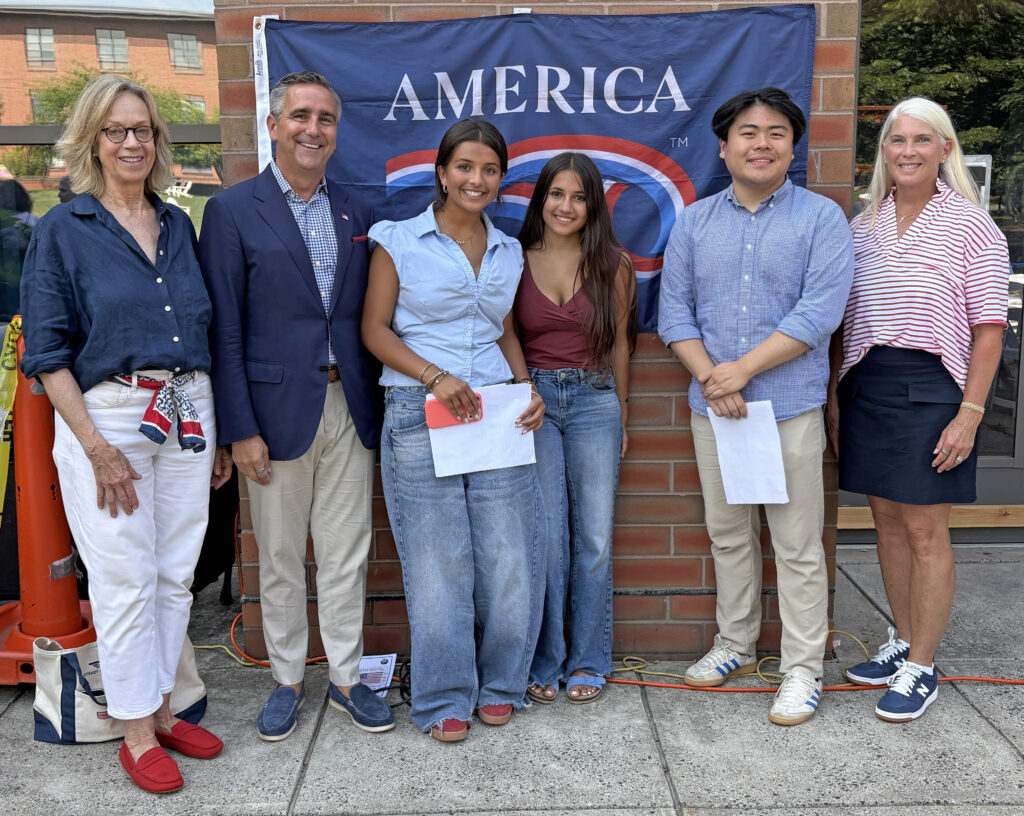
Declaration Day in Darien, July 4, 2026 (from left): Declaration Day organizer Terrie Wood, Master of Ceremonies Hutch Pegler, Seren and Cariad Samy, Lukas Zhou and Declaration Day organizer Jayme Stevenson
Lukas Zhou – DHS Class of ’26 Salutatorian
Good morning, everyone.
Having graduated from Darien High School just a few weeks ago, I can confidently
report that, at least in this town, high schoolers will read and annotate the Declaration of Independence for homework twice: once for their US history class and once for their US government class. I’ve sat through our in-class roundtables—these discussions that are sometimes exciting, and sometimes… less exciting—where Jefferson’s citation of natural rights or the list of specific complaints against King George III are brought up and rightfully highlighted as teaching points for America’s founding values.
But, as I’ve taken the past few days to reread the Declaration, a few words that aren’t given much attention in the classroom—the very final words of the document—have stuck with me…
“And for the support of this Declaration… we mutually pledge to each other our Lives, our Fortunes and our sacred Honor.”
In these words, this solemn pledge to one another, our Founders transformed their newfound separation from Great Britain—and, in effect, their separation from the rest of the world—into a story of interdependence. And unexpectedly, this emphasis on community has resonated with me as I reflect upon my time growing up and going to school here in Darien.
No, I have never promised my life or possessions to anyone else. But, I felt a similar sense of trust I smiled knowingly while half asleep at my friends in the school halls (who were also usually half-asleep from a late night of completing homework due the next morning), or as I hugged my classmates who I had never previously gotten the chance to know very well at what feels like our last few summer get-togethers before we all head off to our distinct paths.
So, over time, I’ve come to appreciate how this town embodies an incredibly American trait: the instinct to wave, reach out to, and welcome both the people we know the best and the people we want to know better.
Actually, there is no better example of that trait than this very moment of all of us gathered here, as neighbors, friends, and yes, as total strangers, to celebrate our nation’s 250th birthday together. Our Founders built this nation on a pledge to one another. Looking around this morning, I am excited to see that same spirit of trust alive and well here in Darien.
Thank you all for your time, and Happy Fourth!
Seren Samy, Sophomore, the Hopkins School
Good morning, everyone.
Political power is entrusted to the People. Where we are, that principle feels almost self-evident. But in 1776, it challenged centuries of monarchy and fundamentally changed the course of history.
That is why I chose this line from the Declaration of Independence:
“To secure these rights, Governments are instituted among Men, deriving their just powers from the consent of the governed.”
To me, this is the intellectual heart of the Declaration. In a single sentence, Thomas Jefferson rejects the belief that governments derive their authority from kings, wealth or divine right. Instead, he argues that a legitimate government exists only because its citizens choose to give it authority. The government is not the source of the people’s rights, rather it is the guardian of them.
That distinction is what made the Declaration revolutionary. Before the American Revolution, most governments viewed power as something possessed by rulers. The American Revolution turned that idea upside down. It argued that authority flows in the opposite direction: from the People to their government. Leadership, therefore, is not a privilege to be claimed, but a responsibility entrusted by the citizenry.
250 years later, this principle remains just as significant. Around the world, we continue to witness conflicts and governments where citizens struggle to influence the decisions that shape their lives. These realities remind us that representative government cannot be assumed. A society is strongest when its institutions are accountable to its people and when its citizens are free to express their views with no fear.
The same principle continues to shape our own democracy. Americans will always disagree about policies, elections and the decisions made by those in office. Those disagreements are not signs of a failing democracy rather than evidence of a healthy one. What matters is that every leader, regardless of party or ideology, remembers that public office is an obligation to serve the people rather than a position of personal power. Likewise, citizens have a responsibility to remain informed, participate in civic life and hold their government accountable.
I believe that is why this sentence has endured for two and a half centuries. It is not simply a justification for American independence; it is a definition of legitimate government itself. It reminds us that freedom is sustained not by the authority of those who govern, but by the continued participation and trust of those being governed.
I would like to leave you with this thought: The greatest innovation of the Declaration of Independence was not merely declaring freedom from Britain. It was declaring that political power originates from the People, given to the People.
Thank you.
Cariad Samy, 8th Grade, the Hopkins School
250 years ago today, the Declaration of Independence was issued, taking the first step to separate the thirteen Colonies from Great Britain. Today, I’ll be reading a specific line that I found to be really important.
“[M]ankind are more disposed to suffer, while evils are sufferable, than to right themselves by abolishing the forms to which they are accustomed. But when a long train of abuses and usurpations, pursuing invariably the same Object evinces a design to reduce them under absolute deposition, it is their right, it is their duty, to throw off such Government[.]”
This line tells us that men are often willing to suffer and allow their government to control their lives, just because it is easier. Staying quiet was safer than fighting back. Signing the Declaration meant the risk of execution.
But these men did not just stay quiet – they believed it was their responsibility to separate the Colonies from Britain and end what they called “a long train of abuses.”
Breaking away from the British government took incredible effort, courage and bravery. Each signature meant the risk of execution.
They believed that the King was a despot and confronting him was worth the risk.
What the people wanted was a government where all men were created equal, and no single person had all the power. We now live in the country for which they fought. This line has lasted 250 years, and shapes all of our lives. They did not just break from the British – they taught us a lesson that still remains: The people have the power and it is their duty to keep it.