
Unstructured Fun: A Critical Component of Childhood, and the Adults Our Kids Become
Mind Set | written by: TIERE HESSERT, Darien mom, and M.Ed., Bank Street College of Education
photo by: BAMBI RIEGEL | riegelpictureworks.com
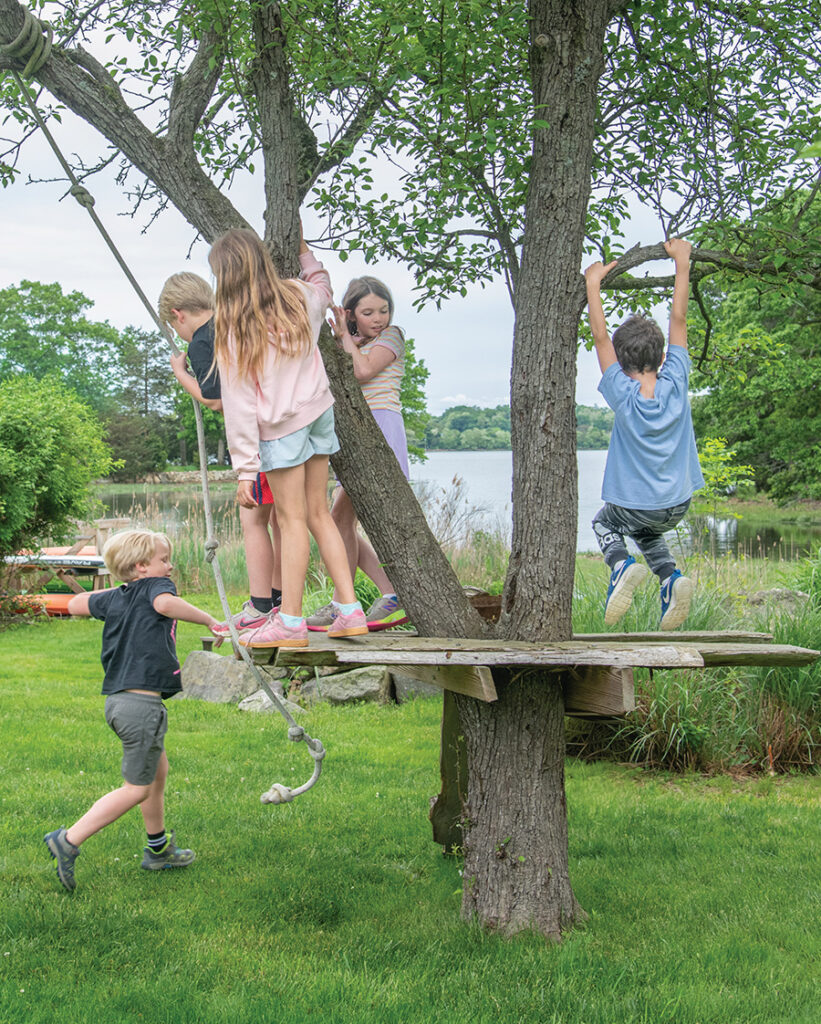
Kids on Noroton Neck at play
IN DARIEN, childhood often looks idyllic. Kids play at playgrounds, sports fields hum with activity, and school communities are deeply engaged. But beneath the surface of this high-achieving, highly supervised culture is a growing question: Are our children actually getting enough freedom to grow?
Across the country, researchers, psychologists and parenting experts are increasingly pointing to one surprising answer to the youth mental health crisis: more independence, more unstructured play, and fewer adults constantly directing childhood.
Organizations like Let Grow — co-founded by social psychologist Jonathan Haidt and parenting advocate Lenore Skenazy — argue that modern childhood has become overly controlled. Children today spend far less time than previous generations roaming neighborhoods, inventing games or navigating small risks independently. At the same time, rates of anxiety, depression and emotional distress among children and teens have risen dramatically.
Psychologist Peter Gray, who has spent decades studying childhood play, argues that free play is where children develop resilience, confidence, emotional regulation and what psychologists call an “internal locus of control” — the belief that they can handle challenges in life. Without opportunities to make decisions, negotiate conflicts, get slightly lost or recover from mistakes, children may begin to feel helpless and dependent on adults for reassurance.
In an interview with the Harvard Graduate School of Education, Gray explained that overprotected children often do not develop confidence in their own abilities because adults are constantly solving problems for them.
This idea is at the heart of Let Grow’s work. The organization encourages families and schools to intentionally give children more autonomy: walking to a friend’s house, making breakfast, hanging out in town, organizing neighborhood games or handling age-appropriate responsibilities without adult intervention.
Independence does not mean neglect. It means gradually trusting children with experiences that help them build competence.
That distinction matters deeply in communities like ours, where parenting culture can unintentionally drift toward over-management. Many parents feel pressure to optimize every aspect of childhood — academics, sports, safety, enrichment and future success. Calendars fill quickly, and adults supervise nearly everything. Childhood becomes carefully curated.
But children do not necessarily thrive under constant optimization.
Unstructured play — especially with mixed ages and minimal adult interference — teaches skills organized activities often cannot. Kids learn negotiation, creativity, leadership, risk assessment and conflict resolution. They invent rules, navigate personalities and overcome boredom. These experiences build resilience, confidence and joy.
There is also growing recognition that childhood independence can make parenting itself less exhausting.
We have all heard of the “mental load” parents have. When children become more capable and independent, family stress often decreases as well.
Parent Coach Lorena Seidel often points out: if children are to have 100% control over their life at the age of 18, what do they need to do independently by age nine? Working within the “zone of proximal development” is key: pushing them a bit out of their comfort zone while still being able to complete the task.
Darien is widely considered one of the safest towns in Connecticut for children and families, with very low crime rates, highly walkable neighborhoods near town centers, strong community involvement and many kids regularly biking or walking independently to school, parks, beaches, sports fields and downtown areas as they get older.
Connecticut does not have a strict statewide law saying children must be supervised at all times outdoors or at parks, and there is no exact minimum age for a child to walk around town alone. However, Connecticut law does prohibit knowingly leaving a child under age 12 unsupervised in
a public place “for a period of time that presents a substantial risk” to the child’s safety. In 2023, Connecticut clarified the law to specifically protect reasonable “independent activities” for children — including walking to school, going to playgrounds, visiting nearby recreational facilities and playing outdoors unsupervised — as long as the child is mature enough and not in obvious danger. In practice, parents can legally allow children to walk or play independently when using reasonable judgment about safety and maturity.
Darien remains one of the rare communities where many neighborhoods and downtown centers are walkable and community trust exists. Many parents remember their own childhoods spent outside until dark — riding bikes, building forts and returning home only when called. Those experiences were not just fun memories. They were training grounds for adulthood.
The solution to rising childhood anxiety may not be more therapy, more tutoring or more structured activities. It may involve something simple: letting children reclaim pieces of childhood that previous generations took for granted.
More freedom. More play. More independence.
Less anxiety. Less depression. Less mental load.
And perhaps, for all ages, a little more breathing room and a lot more JOY!