
…to Education, Community & Sustainability
Around Town | written by: PAMELA DEY VOSSLER, photographs by: BAMBI RIEGEL riegelpictureworks.com
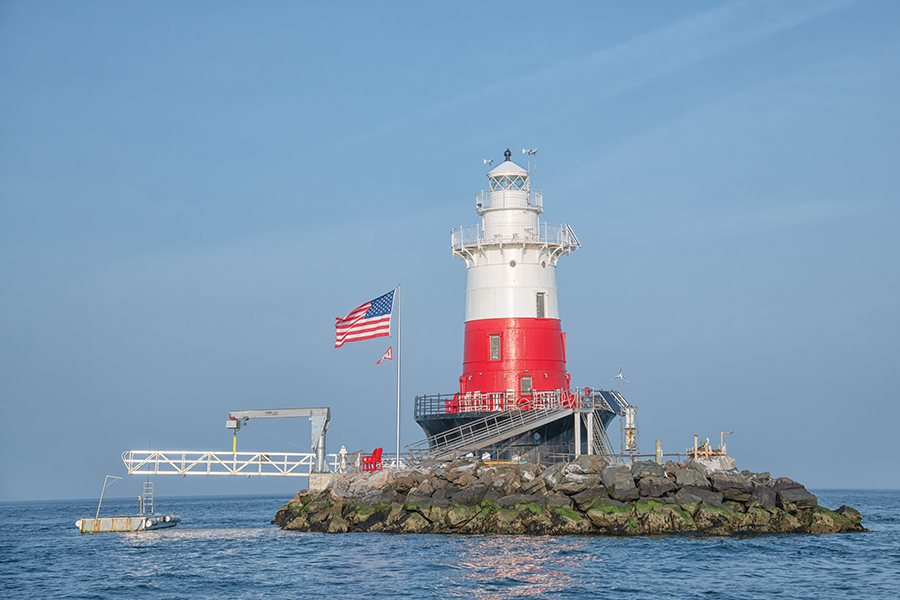
Greens Ledge Lighthouse
THERE’S A FEELING YOU GET when you’re at Greens Ledge Lighthouse, the iconic sentinel on the western edge of Norwalk Harbor, visible from a large stretch of Darien’s coastline. It’s as much for what’s not there as for what is. You’ll hear no sirens at Greens Ledge, no lawn mowers or calls of modern life. Born of silence accompanied by the echoes of days long past, it is the feeling we seek in remote places, one that restores us to ourselves, releasing us to possibilities we may have forgotten we crave.
Greens Ledge Lighthouse has that effect, though located just a mile off shore.
It is a place worth visiting. It is a place worth saving. Led by the Pettees, a Rowayton family who bought the Lighthouse from the federal government in a public auction in 2016, many in Darien are helping do just that through a “Keeper” program in which individuals, families and organizations help sustain the Lighthouse by using it, sharing it and investing in its preservation for the next generation.
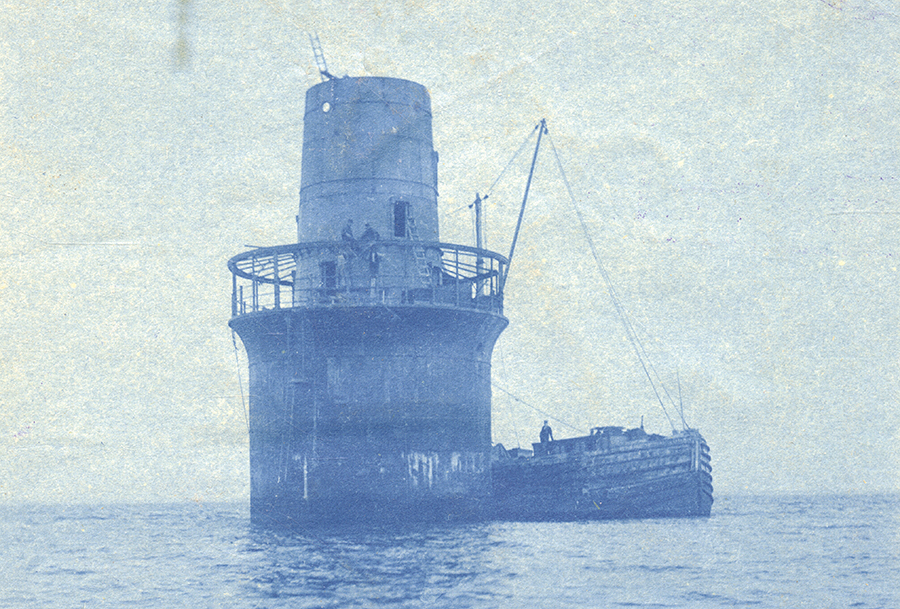
The Light under construction / photo courtesy Greens Ledge Light Preservation Society
Erected in 1902 to warn boats off the ledge it marks, Greens Ledge Light is a cast iron tower that rests on a 30-foot caisson. Still a key navigational aid, it rises 60 feet to a light (now LED) that was originally fueled by kerosene carted up from the basement seven levels below. The protective rip rap surrounding the Light came in 1933—30,000 tons of granite from the excavation for Radio City Music Hall, defending it during the devastating Hurricane of 1938 as waves crashed up to its sixth level. Keepers tended the Light in two-week shifts until 1972 when the U.S. Coast Guard, which oversees the Light, automated its warning systems.
During World War II, the Light served as a lookout for enemy subs and it has been feeding wind and barometric pressure readings to the National Weather Service since its beginning. Through the 1920s and 1930s, it monitored the steamships ferrying up to 12,000 visitors a day from New York to the now vanished Roton Point Amusement Park. It has inspired masterpieces from fine artist Walter Dubois Richards, and F. Scott Fitzgerald’s The Great Gatsby. In 1990, it was added to the National Register of Historic Places.
By the time Tim Pettee, a retired financial industry executive, and two of his four children passed it on their family boat the summer of 2016, it was nearly forgotten, a crumbling mass of rusting iron, cracked walkways and decayed railings that very nearly collapsed into the Sound. They saw something different.
Noticing a sign, Tim’s then 16-year-old daughter Lizzie said, “Dad, the lighthouse is for sale. Let’s buy it,” recalled Tim, a devoted family man who grew up in Westport, boating around Greens Ledge Light as a kid. He envisioned a legacy for his family to rally around, perhaps a place for them to gather.
Little did he know what awaited him on the other side of the purchase, for his son Alex too, now 34 years old, who was also on the boat that day.
Shortly after the sale at a family dinner, Alex, a finance major out of Georgetown University who now runs his own investing company, famously remarked, “Dad, just don’t leave us a pile of rocks,” Tim said. “He’d been researching it. These things come down.” In fact, a lighthouse exactly like Greens Ledge Light off of Staten Island had been swept away just a few years earlier during Hurricane Sandy.
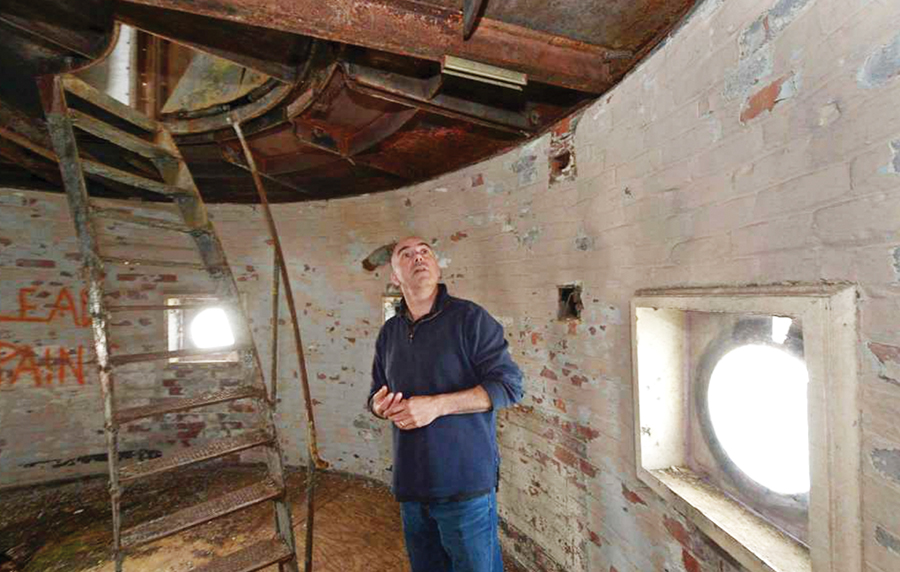
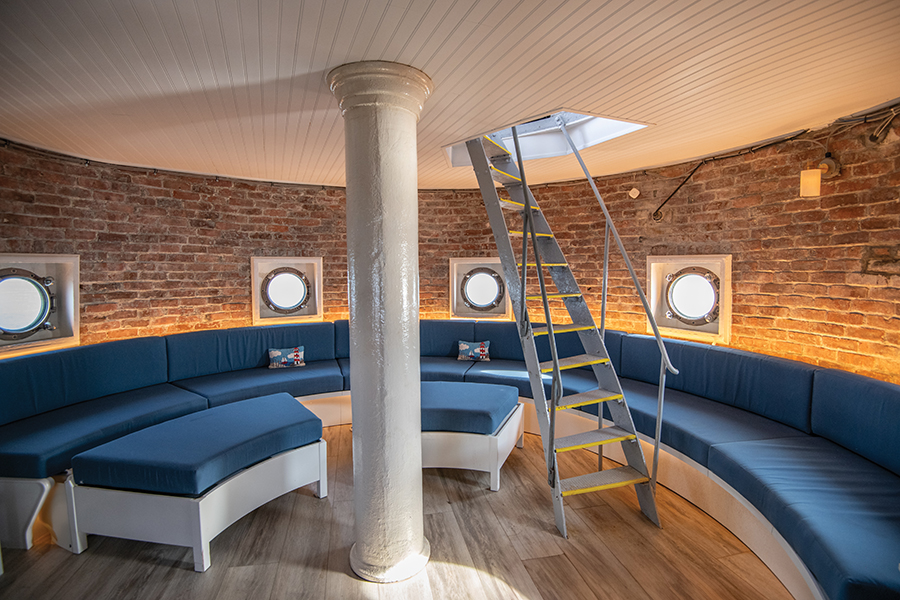
The 4th floor of the Light, before and after the restoration; Originally a work space for keepers, it is now a gathering spot for visitors
They went to work, creating a 501c3—the Greens Ledge Light Preservation Society, with locals Shannon Holloway and Brendan McGee. They donated the Light to the Society. They found other donors to join them in supporting the restoration which took four years. They learned about solar power, wind power, lead paint and asbestos removal, plumbing and desalinization systems, how to build when floors slope, walls are rounded and nothing is plumb, ways to reconstitute nearly every type of material that is gone or perilously close to it. They learned the right kind of dock system for a place buffeted by waves and weather and how to remove 20 layers of paint off brick – by hand; how to adapt sustainable systems to exist off the grid, and so much more. They’re still learning.
It’s crazy what you have to know to save a lighthouse.
“There was nothing straightforward with the restoration,” explained Alex who dove into the family project early on, somehow fitting in multiple trips to the Lighthouse each day, transporting workers and mountains of material, around his work responsibilities.
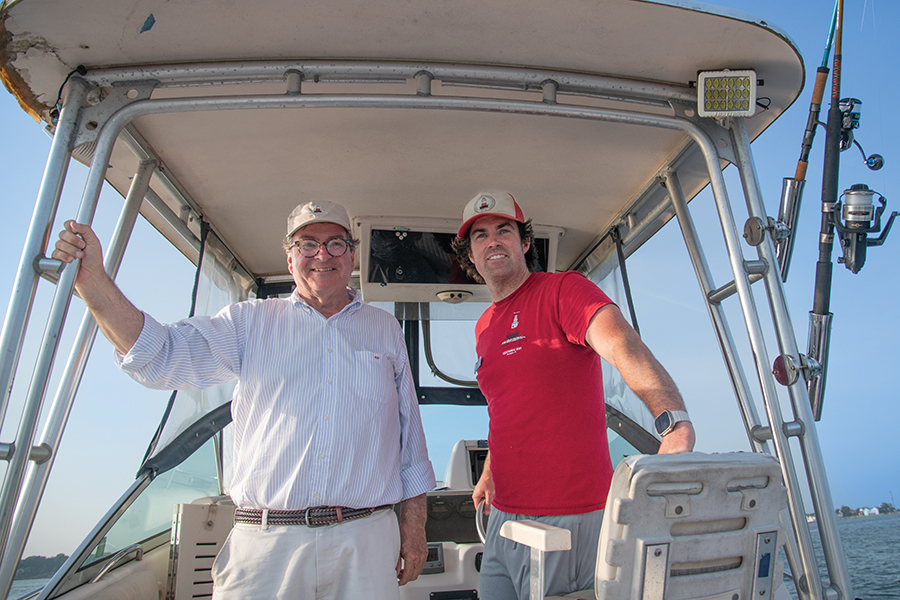
Tim and Alex Pettee
A modern-day keeper, as his dad calls him, Alex still travels to the Lighthouse most days of the week, fixing things, maintaining things, making sure all is running smoothly, purely as a volunteer.
“I think I was a little dragged into it at first, but not unwillingly,” said Alex of the Lighthouse. Spurred on initially by the threat of collapse and the visible progress they made in restoring it, “It became a team effort and I think we all sought inspiration from it,” he said. “It helps having a really passionate group of people that want to support it too.”
“It was a fantastic weak moment when I said ‘Yes let’s do this,’” said Tim, who leads community outreach for the Light. “But I’m glad I did,” he continued. “I didn’t know at the time why it mattered. I know now.”
It matters for his family, certainly, in the legacy they are building. When asked what strikes him most about Greens Ledge Light, Darien’s John Sommi – an early and ongoing supporter, said, “The passion and commitment of the Pettee family to preserve it.”
With its sustainable systems and its osprey nest and cam (built and installed by Alex), it matters environmentally. “It is a model for how preservation and sustainability can go hand in hand,” agreed long-term supporters Tom and Sophie Murphy, also of Darien.
It matters for the community too. With its restoration, it has become a ubiquitous symbol of pride throughout Norwalk and Darien, reminding us of what we share and the good that binds us.
“My hope is that the Lighthouse can endure, so that it will continue to serve its dual mission as a navigational aid and a beacon of our community,” added John.
It matters scenically. Had the Lighthouse come down, the Coast Guard would have replaced it with a light atop a cell tower.
“Of course anybody would much rather look at a glorious, quintessential lighthouse,” commented Sherry Ramsay of Darien. She and her husband Brian have been supporting the Lighthouse for years. “But it goes beyond that as far as using it as a teaching tool,” she continued.
Because it matters educationally too, massively.
“Lighthouses have long been symbols of strength, guidance, resilience and hope,” said the Murphys. “The Greens Ledge Light is not only a reflection of all those things but also a living structure that provides opportunities to residents to engage in the environment, learn about the coastal maritime history of our area and, importantly, educate ourselves about what we need to do to protect this heritage and the waters of Long Island Sound,” they added.
That goes for young people too.
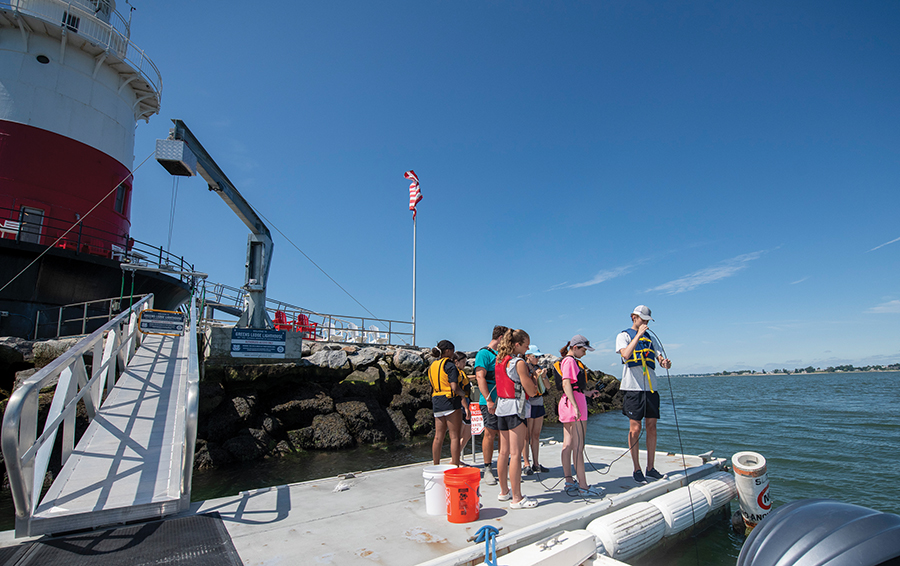
SoundWaters students sampling the water at the Light
“We are always looking for creative ways to immerse students in learning from Long Island Sound,” said Leigh Shemitz, president of SoundWaters, a Stamford-based non-profit dedicated to protecting Long Island Sound through education and action that started bringing students to the Light last year. “The history of the site comes alive as they walk up the narrow brick stairwell, touching the walls that were home to keepers over 100 years ago,” said Leigh. “They appreciate the restoration itself — how a committed bunch of adults took something derelict and brought it back. The Lighthouse also offers students a dramatically different sampling environment from Stamford Harbor and the comparisons in the results of their research offer a real teachable moment about microenvironments and habitats,” she continued.
…which plays right into plans for the next 100 years.
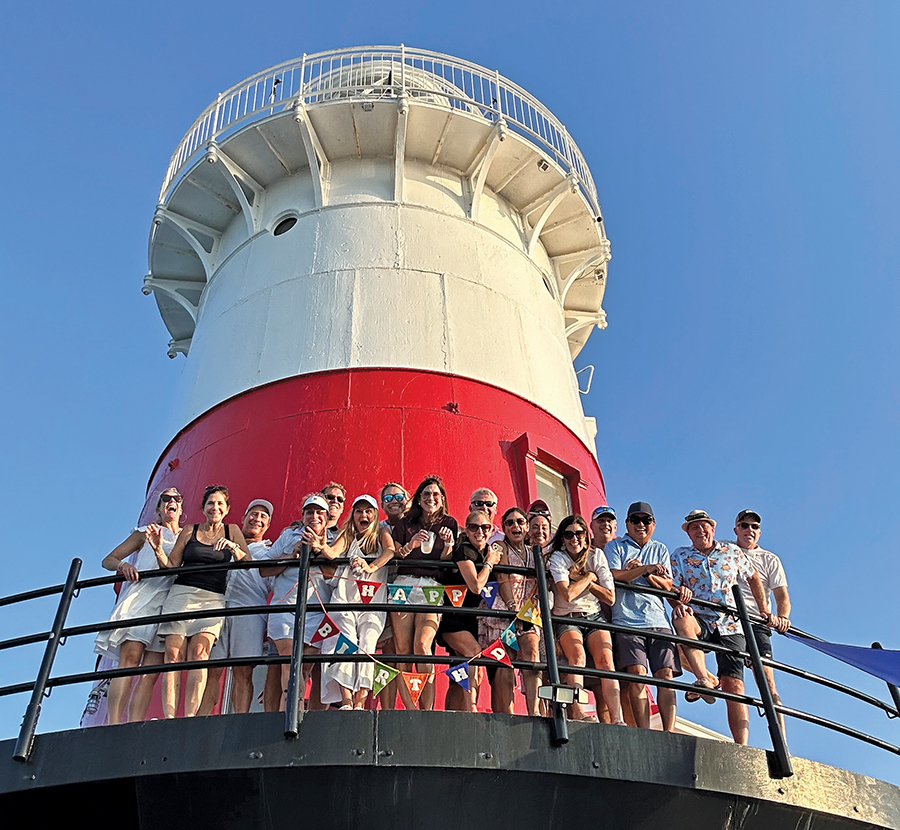
Keeper supporters Brian and Sherry Ramsay hosting an event at the Light
While still private, the Pettees feel strongly about realizing the Light’s educational potential for schools throughout the area, keeping it sustainable and making it available to the public. “We had the benefit of learning from many other lighthouse restorations worldwide. We found that the best way to preserve a lighthouse isn’t to seal it off—it’s to keep it active, useful and relevant. Usage keeps the rust away,” explained Alex.
“Many don’t realize the Lighthouse is at the heart of a growing effort to provide meaningful educational programs, community engagement and public access,” said Darien’s Anne Walker who, with her husband George, is another longtime supporter of the Light. “These initiatives inspire learning, connect people to local history and the environment, and foster a deep sense of place. It is an invaluable cultural and educational asset for our area,” she added.
For more about Greens Ledge Light Preservation Society, visit savegreensledge.org.