
Fine Dining in Darien
The Good Table | written by: PAMELA DEY VOSSLER | portrait by: BAMBI RIEGEL | riegelpictureworks.com
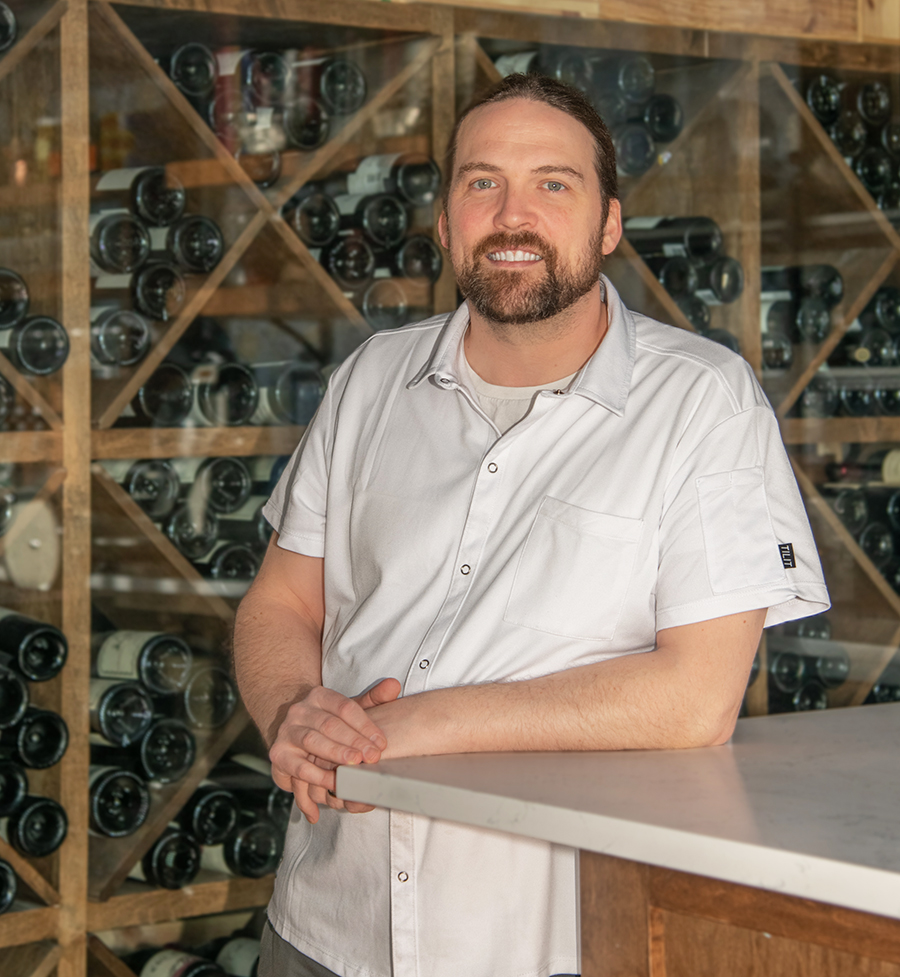
Chef Jared Sippel
JARED SIPPEL IS CHEF. It’s what his staff calls him, as well as anyone who knows his food. Not that he asks for it. It is simply a truth—straightforward, well-earned, pure …and the reasons for it speak to what you will find at L’Ostal, the Provençal restaurant he owns and runs.
Opened in 2021, L’Ostal at 22 Center Street in Darien reflects the full complement of flavors, ingredients, places and influences Chef brought with him from 15 years of 60 to 70-hour weeks spent working for some of the world’s top chefs at a string of Michelin-starred restaurants including Frasca in Boulder, CO, Quince in San Francisco and L’Oustau de Baumanière in Provence.
“It wasn’t just about Michelin,” clarified Chef. “It was about the best. I wanted to work for the chef, not the Michelin stars,” he continued, revealing his authenticity and his drive as a young chef to go above and beyond, to learn, to prove himself, to excel.
And he did, in a job cooking at Frasca while he was at the Escoffier School of Culinary Arts in Boulder where he finished first in his class. That earned him the school’s top internship at the L’Oustau de Baumanière. They hired him back for a year after his graduation which solidified his allegiance to the flavors of Provençal cooking, riveted as he was by the stereotype-busting culinary influences of Italy’s Piedmont region and, by association, those of Austria, Germany, Slovenia and Czechoslovakia, as well as the Pyrenees, northern Spain and its Basque region.
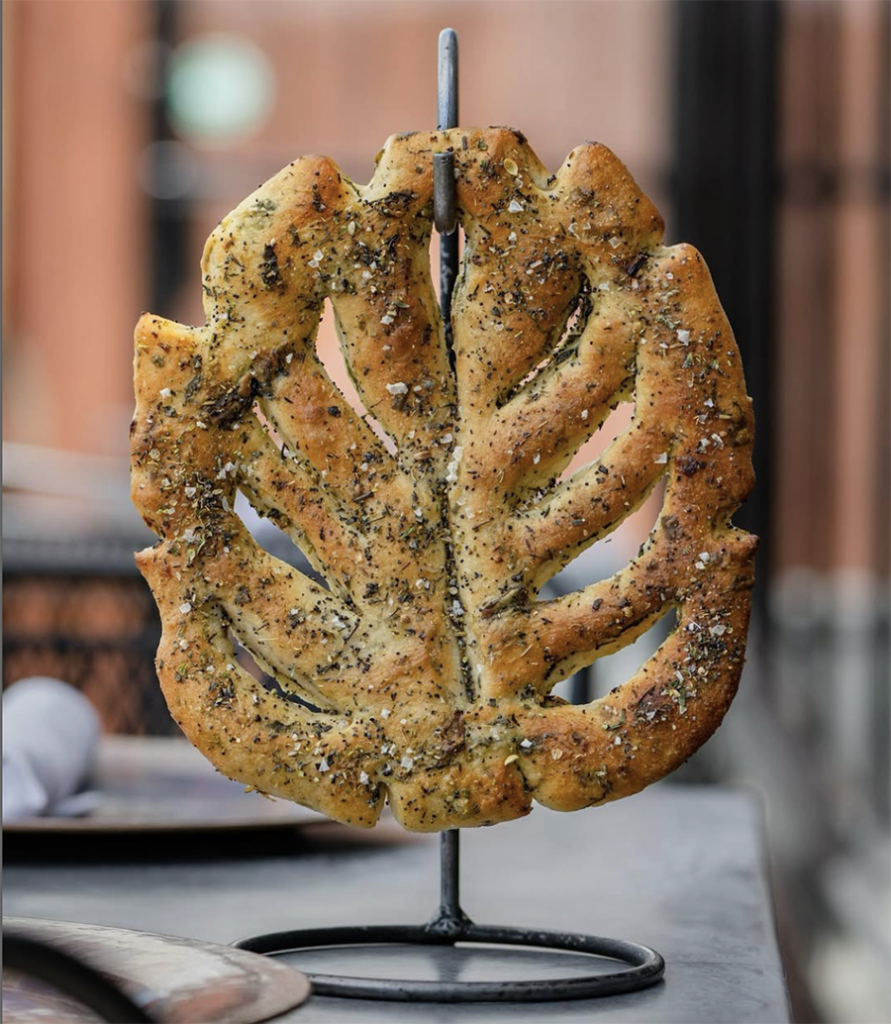
Chef’s Fougasse | photo courtesy of L’Ostal
It’s why, in addition to the Italian-influenced vegetable- and olive oil-driven dishes typical of Provence, you’ll also find Moroccan couscous with lamb and harissa at L’Ostal, as well as fougasse, a cousin to Italy’s focaccia, beef ragu and cassoulet in a menu that changes to coincide with what is in season.
You will never, however, find dishes that are over-produced or contain ingredients unrelated to each other, combined in ways contrary to their origins.
“In every dish that I do, there’s a connection from the product to the region it comes from, to where I’ve worked, to where I saw it and where I’ve been,” explained Chef of his approach to cooking, which comes from a place of passion rather than ego. You can taste the difference.
“Over the years, I picked up a lot of fancy things,” said Chef of the decorative flourishes that mark typical fine dining, “I prefer to focus on flavor.” And while his food appeals visually, he would rather his customers go, as he says, “weak in the knees from what’s going on in terms of the flavor and the layers” in their meal. His aim? To take them where he has been.
After L’Oustau de Baumanière, Chef returned to Frasca. Next, he was recruited to Quince to work as sous chef under Chef Michael Tusk, regularly showing up at 6am following a late close to accompany Tusk on shopping trips for the day’s ingredients.
“A lot of the cooks would back out,” recalled Chef. “I had to do it. I wanted to show that I could work these 16-hour days with the best of them,” he continued.
“I took it as a challenge, but I was learning so much as well. I was constantly turned on by the amount of knowledge that I was getting. My three years there were like working six years anywhere else,” he added.
He understood what it took to be the best.
It’s a work ethic he learned growing up in small town Iowa, with a father and uncles raised on a family farm where sports were out of the question given the demands of the farm. While none of them stayed in farming, the values stuck.
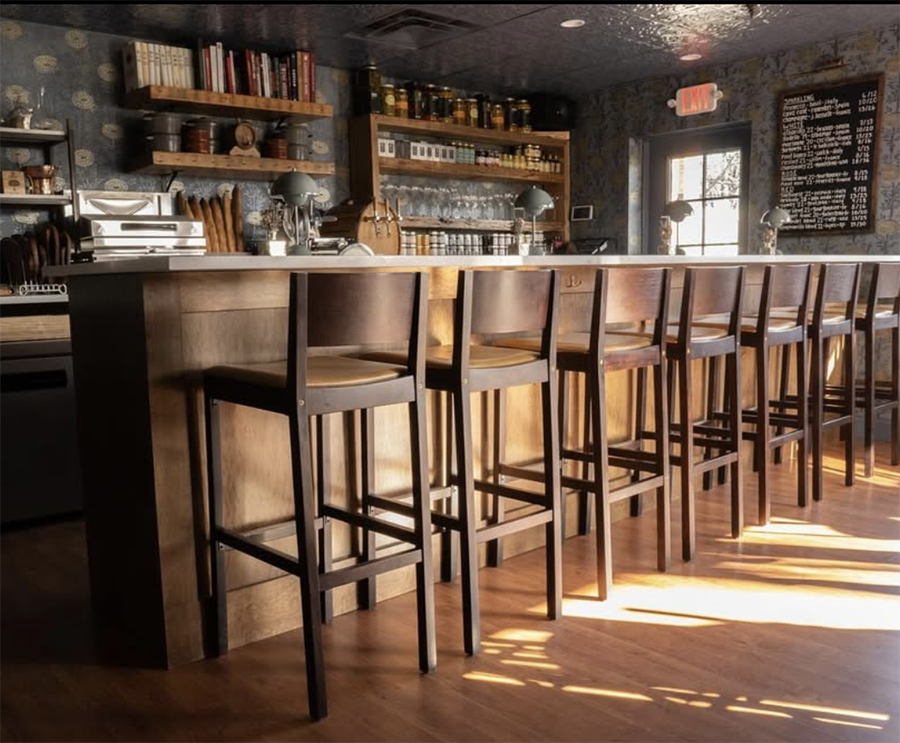
The wine bar at L’Ostal where you can sample the unique regional wines Chef curates himself | photos courtesy of L’Ostal
“I knew that if I wanted (something), I had to go show that I could do it. I had to be tougher than everyone else,” said Chef of his humble origins. “In this industry, it is about pushing yourself because restaurants don’t become great without it,” he added.
It helps when you have Chef’s kind of certainty. He felt the call of the kitchen early on, cooking for his family when he was just a kid, working in family-style restaurants in his hometown through high school then cooking throughout college at a higher-end restaurant. By the time he was 22 years old, he’d been cooking for seven years.
While he earned a degree in journalism and mass communications from the University of Iowa as a hedge, he knew innately he’d never need it.
From Quince, he was called back to Frasca as chef-de-cuisine. Brooklyn Fare brought him east in 2015 after he beat a cadre of talented chefs competing for the top spot in an expansion of the famous three-Michelin-starred eatery to Manhattan. Due to a change of concept, it did not open so Chef struck out on his own, opening a 100-seat restaurant on 24th Street between 5th and 6th Avenue in 2016.
When COVID hit, the doors shut. There is no carry out in fine dining.
“I didn’t know what I was going to do but I also did. It wasn’t a question. It wasn’t like I was selling everything. I was putting everything into storage until I found a new space,” said Chef who had already moved to Darien with his wife, who grew up in Riverside and was expecting their first child.
Living here notwithstanding, it didn’t have to be Darien. It just had to be. He viewed every available space between Greenwich and Fairfield before settling here.
With certainty (and a lot of knowledge and experience) comes confidence and when you’re true to yourself, good things happen.
“If I had been thinking ‘what’s the smart move?’, it probably wouldn’t have been fine dining post-pandemic in a town with no fine dining. But that’s not how I think,” said Chef. “I didn’t do this restaurant because I thought this is what the town wanted. I did this restaurant because this is my food.”
…and as it turns out, it is precisely what Darien, and the surrounding area, want. (If you’d like to eat at L’Ostal, you will need a reservation.) L’Ostal is the sort of fine dining to be coveted in any city in the world. But it is here, luckily, transporting all from its corner of Darien to every corner of Chef’s extraordinary experience.